talent identification
2014-03-09
Pathways update
Things are changing, for the better
About a year or so ago I wrote this article on pathways into sprint in Victoria. Things are changing a little, Glenn Doney is the new VIS head coach and he's making some changes to how riders are recruited into the VIS sprint program. It's now reaching down a little lower in age groups than it has in the past, watch for some interesting announcements soon from the VIS on how that's working.
The pathway is now :
VIS -> AIS
Some of you may remember the sprint academy, it was a layer between the state institutes, eg VIS, NSWIS, SASI, WAIS etc and the AIS program, designed to fill a void. It looks like the SIS/SAS layer is being broadened a little and mostly absorbing the role that the academy filled for a year.
So, how is this relevant?
We're working on setting up a layer below the VIS to develop sprinters, to feed riders into the VIS program. A little like the old NTID program was, a layer where identified promising juniors are pulled into a sprint squad that will train seperatly from the VIS squad. The VIS squad is now quite large, and coached exclusively by Hilton Clarke, with my assistance doing motorbike work and power meter stuff etc. I'm not directly coaching anyone in that VIS sprint group. I think we're going to call the new developent squad the Victorian Sprint Developent Squad, or VSDS.
So the pathway will end up, as soon as we can get it all sorted :
Club -> VSDS -> VIS sprint -> AIS Sprint
There's a lot of work to do to get it running and we need buy-in from a number of groups, so the politics will be a challenge, but I'm confident that we can have it going soon and it will be a leading structure, that the rest of the country may duplicate in time.
2014-03-06
A great quote
It's not over for us, it is just going to be different
Yep, things are changing in the Vic sprint scene, quite dramatically. Hopefully very soon we'll be able to quash the rumours, put out the fires and show you all a new structure, with progression and direction and it will be a big win.
2014-02-13
SSS as a WSS, in Perth?
Check this out, we're spreading ...
From Clay Worthington, WAIS sprint coach :
Hello All,
Please pass word around that TCWA has agreed to run a winter sprint series in Perth. We have targeted the last Friday of every month starting in April (and with one exception … please see attached), and we think it doesn’t clash with many major events (although there are likely to be clashes with road events). The better it is attended the better the racing experience will be for everyone.
Racing format is still being developed, but we’ll start smart and let it grow. At this time we’re planning a F200 qualification to determine racing groups by ability (not age, gender, or category). We’ll run 2up match sprints, derby’s, and Keirins depending on numbers and all in sprint formats and distances (i.e. sprints 2-3 laps, derbys 2-4 laps, Keirin 6-8 laps). I’m not planning any “Coach’s Kilos”, but will keep working on DB and Muzz to line up opposite one another. J If you attend, expect to race 4-6 times plus a 200.
Registration will run through TCWA as per a typical Fri Night Racing (i.e. Tues midnight deadline, through TCWA website, or email Ken Benson), but please feel free to express your interest to me as we’ll need attendance to keep it running. Same $15 as is typical.
At this time, I’m expecting to be registration desk, session coach, commissairre, motorcycle driver, etc as it’s being listed as a TCWA Sprint Training session; but we’ll be racing for training. Warm up starts at 6p and racing starts at 7p with qualifications, and we’ll plan to finish by 9p. Electronic timing gates will be on track with hand timing for back up and to deliver splits.
If you have questions, please call/email/text me. If you know of folks who want to sprint but haven’t gotten a chance yet, please tell them their opportunity is here!
Thanks for your attention.
Clay
2013-12-27
Is winning everything?
How important is winning?
Over the last few months I've had reason to answer the question, in a couple of different contexts, "How important is winning?".
It's a very interesting question indeed.
Ultimately, we race to win. In sprint, it's not about finishing the race, unlike most of the people who race endurance events. Just to finish the Warny for example, is a win. Second place in a match sprint is not a win. Finishing a flying 200 is not a win. It sucks to lose a sprint and still get a medal. In some ways bronze is better than silver, emotionally. You won bronze, you lost to get silver.
How important is it? It's very context-sensitive. If you're a recreational sprinter racing the Summer Sprint Series, it's important to be competitive and have fun, that's why we grade it and it's a round robin format. For development purposes, this is an ideal format, plenty of racing, plenty of chances to win, and try things and to try things that don't necessarily work the way you expect them.
If you're a coach in a government funded elite squad, winning is all-important. Head sprint coaches at the Olympic games for Australia, Great Britain, Germany, France etc are there to win. That's their job. It's absolutely vital that they win. They can't all win, and those that don't can get the chop by their organisations if they don't. It's very intense and the stakes are high. It's only a bike race, but it's not! Millions of dollars of goverment and private funding, years of dedication and sacrifice from the athletes and the coaches, there's a lot at stake. When it goes badly at that level, it's brutal.
Compare this to Cool Runnings. We've all seen it, it's a classic and one of the best sporting movies ever made. Those guys won, not the race, but a battle against almost overwhelming odds to get to the start line. If you're not at the top level, getting to the top level is a win.
Think about Lori-Ann Muenzer in our context, or Sir Chris Hoy, who was a pioneer of what is now one of, if not the, best sprint programmes in the world. Hoy's story really is amazing. His autobiography is a must read for anyone in sprint cycling.
From a development perspective, working with a development group like I do with the Vic sprint group (15 to 18 year olds, mostly) and some of the aboc guys, winning bike races isn't as critically important in the short term. It'a a long term goal - we ARE training the kids to win races and it's important that they do, but it is at least as important that they develop the strength, power, speed, skill and emotional maturity to cope with the pressure to win that they will face if they make it into an elite squad.
These attributes can take time. A junior athlete with potential may not be winning much at first, it may take years of hard work for them to progress to the level where they are winning races and if winning is everything, these guys drop out. We need them (and the seniors!) to concentrate on improvement and processes. You'll hear a lot of "focus on the process". This means focussing on what you're doing, whatever it is, and letting the results take care of themselves. If you're focussing on a solid start out of a gate, arms straight, head up etc and not on "I must win this race", you'll usually do a better start, and are more likely to win, or at least, give yourself the best chance you have to win. The athletes need to protect themselves from this pressure (pity the coaches!) and have sports psychs to help them with it. In order to win, they need to forget about winning. Just like tennis in a lot of ways. There are some very good books on tennis winning, I can recommend The Inner Game of Tennis by Timothy Gallwey. Get it, read it. It's good.
Back on topic, winning is, ultimately, what it's all about for us, but we must approach that with a long term plan and process and with athletes fully aware that while we're preparing them to win, we want to see focus, dedication and improvement. Tick those boxes and the wins will come.
2013-10-01
Even when they have it all
They want more!
Minor rant time.
Sprint is starved for competition. Famished. We get next to nothing. Until the NJTS came along (and I, and a few other coaches, lobbied like mad to get more sprint-ish races included in it, thank you Max Stevens for listening) if you were a sprinter as a junior, you get two, maybe three or four if you're in Melbourne, chances a year to compete. Club championships, state titles, metro/country/Vic Track Cup and nationals if you made it that far. I'm going to take credit for my Summer Sprint Series as well, but that's only club stuff and we have 5 rounds a year. So maybe, if you're in Melbourne, not including NJTS, you can, at most, have 9 chances to race sprints per year. Nine. Count them.
Enduros - HUNDREDS! Clubs fall over themselves to offer junior tours, there's track racing two to three times a week or more for enduros, more road races, crits and other stuff than I can count. Hundreds of opportunities to race. The "sprint" races at the NJTS are not match sprints, they're short (2 laps) events and baby keirins that enduros can be competitive in. The NJTS gives us (sprint coaches and talent ID people) a chance to see potential sprinters if they pop up from the default endurance setting that all clubs impose and maybe we get a chance to rescue these kids if we're lucky. It gives the kids born with some sprint talent a chance to actually stand out in some racing before they give up and go play footy because they're all fast twitch and can't hang on up some hill somewhere because that's not how they're made.
The NJTS program is weighted to the advantage of the sprinter? Take a step back and look at the big picture. Our sport is so massively, overwhelmingly biased to endurance that the suggestion is absurd.
2012-09-19
Pathways
Where do you want to go?
I've been thinking a lot about this, as over the past few years with working for Hilton (it's been almost 4 years!) in the Victorian Sprint Group program, we've seen some amazing growth and some brilliant results. It's not all been perfect, of course, lots of hard lessons have been learned and there's more to come. One of the things we need to consider is pathways into the VSG. Until reasonably recently, we'd pretty-much say yes to anyone that wanted to have a go, sprinters being rare animals. But, these days, we've got a pretty good hotbed of talent here and the VSG is full.
So what do we do with the kids that want to have a go?
We need pathways into the squad. I very briefly discussed this with Hilts yesterday, and it's softly-softly at the moment, but some ideas to toss around, based mainly on talent ID, where talent isn't just being able to ride quickly as a J15, but also being committed. We (Hilts and I) put our hearts and souls into the VSG, it's all consuming for both of us, and we expect that riders in the program are equally committed. If you're committed and prepared to bust your arse for years, we'll move heaven and earth to make the program fit you in.
How do you, as a J15 or a J17, show commitment? It's easy to see speed, just race fast. Are you in it for the long haul or just dabbling for a bit of fun before you go and do something else? There's nothing wrong with dabbling, but the VSG is not for that.
Is it realistic to expect a J17 to show long term commitment? I think it is, to a point. If you can't ever see yourself as being an Olympian sprinter, then you're dabbling - if it's something that you want, now, then we're interested in you. We know things change, and life intervenes all the time, but if it's not on the radar, you shouldn't be wasting our time. The kids I've fed up into the VSG want (at the moment) to be Olympians, Perko and Anna are their heroes. This is really important.
So, some pathways, I run a sprint group outside of the VSG, which you all know about, the aboc Sprint Squad, it's a bunch of masters guys and developmental kids and some senior riders who for various reasons aren't in state development squads (but may be working towards them). That's one pathway into the VSG - if you ride in my squad, I'll see you, and see how committed you are as well as if you have physical talent. If and when the time is right, I feed you up the chain into the VSG. I've done this with a few riders so far. This means paying me though, and that's possibly open to suggestions of nepotism, it certainly can't be the only way in and it isn't.
Other pathways - work with another coach, specialise in sprint (if you can find a coach that will let you as a J17 or J15, they're rarer than they should be), get them to speak to Hilts if you're showing the right stuff. Win sprint at Junior Vics beating the kids in the VSG, that's sure to get our attention! Get spotted by a coach or testing through Cycling Victoria, as an example Carnegie-Caulfield riders sometimes get pulled up into the VSG if they show enough talent at their club training sessions or testing sessions.
There's others - if you think of some, I want to know!
2012-08-29
In defence of the new gear restrictions
Not everyone's happy
Earlier this week CA announced that J17 gear restrictions would be lifted to a 7.0 meter rollout, which is around 90 gear inches, it was to be lifted to 86" (6.75m), up from the previous limit of 82" (6.5m).
Many of you reading here know I am very much in favour of this, but not everyone is pleased. I hope to calm the storm a little, or at least provide some argument in favour. Note please that this is my opinion, and I am not representing any organisation except for aboc Cycle Coaching (me!) when I write this. Furthermore, I don't have any influence on the people that made the decision that I am aware of. I don't even know who they are.
Enough with the preamble ...
Firstly, the rule change does not mandate that every J17 rider ride 90". It means they are allowed to, which is not at all the same thing. J19's are allowed to ride up to 104" or something, they don't, because they usually can't. I work with J19's who can squat small cars and deadlift your fridge, full ... they're not anywhere near being able to rev out the J19 gear restriction yet,. and managing them through J17's is a challenge (be patient, your time will come, being restricted to 82" sucks, but next year ... repeat and hope the kid buys in to the argument).
If a J17 is a great revver, they will choose smaller gears, if they're a big, strong kid, they will push bigger gears. Up 'til now the rules have biased against strong kids and towards super-revvers, at least in sprint, which is where my attention is focused. I expect it's the same in enduro circles. Big, strong kids can't rev as fast as the hummingbirds (heavy legs, can't move 'em quite as quick, but they can accelerate!). We build kids up to be strong so that they can be competitive as J19's and seniors, and not spend another 6 years trying to get them strong enough, this is an even bigger task with girls than it is with boys - they put muscle on a lot more slowly than boys. One of the causes for the loss of elite sprinters after J19 is the almost insurmountable gulf between a J19 and a senior (hey, kid, race Perko, who is pushing 108" or more and Anna who is superstrong! good luck ...). I've interviewed a number of guys who've given it up after J19's and this is a common theme. They don't want to spend 5 or more years getting smacked before they're even at a level where they can keep up and not be embarrassed.
By better preparing J17's to use bigger gears, we hope to lift the standard in J19, and thus, make the transition to senior riders be less daunting. If J17's filters out a lot of the strong kids in favour of super spinners (which, at present, it does), that means J19's are in general, weaker than they could otherwise be as a population, and then less likely to manage the jump into senior ranks. There's loads of examples of this in sprint in recent memory, in particular in the girls, but also many of the boys have failed to make the jump past J19. This is for many reasons, but one is that the jump is too big for most of them to manage in a realistic timeframe.
Some of my colleagues have mentioned that by allowing J17's to push 90", that this will kill the sport and other hyperbole (and a half!), or that we shouldn't change a working formula (hey, it's NOT working! We bleed riders after J19, you haven't noticed?! Where are they all?). Nonsense. The current situation is that strong kids are held back (and they're often some of the best talents, so they go off and play some sport where their talent isn't nobbled), hummingbirds prosper and the less talented kids are off the back on 82". The only difference by allowing bigger gears is that the strong kids will be able to keep up with the hummingbirds. The less talented, or younger, or less developed kids will be off the back no matter what anyway. It happens now, it will continue to happen. I don't think much else will change. If it does, the rules can be changed again.
OR
And this is the rub. Many are suggesting that club racer kids will give it up because 90" is too big and they can't keep up, there'll be no tactical development etc etc. Here's the thing. At club level, clubs are free to introduce their own gear restrictions anyway. You want a race where no-one can push bigger than 82" - NO PROBLEM! Just put it in the race rules. Brunswick did this on Saturday, everyone was on 90" (magic number?!) and it was great. Close races, lots of skill and tactical development. GOOD! We had first year J19's (the ones I trained overgeared last year and got strong and who hated being forced to ride 82" in competition) keeping up with senior sprinters, which made for good training races. But, for opens, state and national championships, the talented kids should be allowed to display their physical talent. It may well keep them in the sport longer and help us find the next group of champions. State and National titles are not "every kid's a winner" races, they're championships and the best kids should be able to win them.
I'm sure there will be people who will cite examples of successful riders who came through our current system, they do exist, and this is good (look closely at their development path before you cite them though, some will surprise you at how they got into the system, Cadel rode MTB, Matthew Glaetzer was a pole vaulter and did not come through gear restricted juniors etc), but we can do better (we have to, everyone else is!) and we can't say everything is great because some physiological freaks have survived it, if they even came through it. Our rules and development programs should not be judged by the success of the very rare genetically gifted athletes that pop up, but rather by the health of the whole ecosystem.
Finally, the knee injury furphy. Where's the corpses? We train our guys overgeared ALL the time, putting out much greater torque and power numbers than anyone else in the state (wanna bet?! I have data ... ), I have not seen a single knee injury. Not one. If a kid isn't strong enough to push a gear (86, 90, whatever) they simply won't be able to push it. They can grind at 60rpm up a hill (that's ok ...) in a road race out at Eildon or the 1:20 etc already if they want or have to. Knee overuse injuries come from throwing kids at huge miles and on badly fitted bikes, not from pushing a gear that's too big for them.
So there you go. I don't think it will kill anything, I think it's for the long term good of developing better senior riders
2012-08-26
Experiment successful
Thank you Brunswick!
Last Saturday afternoon (juniors) and evening (J19's and seniors) Brunswick ran the first of their "DISC-O" night Saturday racing. I'd had a little input into their race format. As anyone reading this knows, my big beef (apart from actual beef!) is that there's never enough racing for sprinters and we wanted to redress that a little.
The format had some of the usual enduro stuff, but it had abbreviated flying 200's (two lap windup) and lots of baby keirins. This is a format that I nagged Max Stevens about until he capitulated for the NJTS for this summer, and I can say, it works! It works really well. The baby keirins were 3 laps (kids) and 4 laps for the seniors (and we'll make them 4 laps for everyone from now on I think), with the bike swinging off with 1.5 laps to go. This is a pure sprinters keirin on little gears. Seniors were restricted to 90". Just about everyone was buzzing about how much fun it was, and how close most of the racing was (and no crashes in any of the sprint events). It was great to see how many of the guys learned and practiced keirin tactics in a low pressure, but very close and intense, format. Everyone got three keirins in the racing.
I got to have a bit of a look at some of the juniors and see if any showed any spark too, so that was handy.
Tick that one off as a win, a big thanks to the guys at BWK for having the courage to run it, in particular Cam McFarlane and David Morgan who made it entertaining and kept everything moving along well.
2012-06-29
It takes more than just 10,000 hours
The seductive argument that practice alone makes champions is wrong
Ok, many of you have heard the story by now, train/practice for 10,000 hours and you will be the best in the world, a champion, an outlier etc. It's the stuff of dreams, you can be the best if you just work hard enough. That's an idea that sells a lot of books.
Unfortunately, it's wrong. Or to be generous, it's incomplete.
I first read about this 10,000 hour thing in Dan Coyle's "The Talent Code". A good book, with lots of things to learn from from a coaching perspective. I've adopted a lot of what Coyle wrote about in my coaching practice, it's good stuff, but it's missing something fundamental. It's also the fundamental argument made by Mathew Syed in "Bounce". Notably, Syed is a table tennis player, perhaps not the most physical of sports. In the recently published "The Secret Olympian" (anon, but it's a British rower, a bit of googling will tell you who wrote it), "anon" writes :
Syed's argument in Bounce - train enough and you'll be excellent at whatever you choose - is seductive. It's probably true for table tennis. But in general, it's wrong. As Bas van de Goor neatly states, 'You can learn to play volleyball; you can't learn to be tall. Genetics count'.
 These guys are not going to be successful volleyballers, not if they spend 20,000 hours of practice in the best hotbed in the world. Genetics matter. You can't be an elite athlete in most sports without winning the genetic lottery at birth. Sure, if you train you will improve, but how good can you get? Can you be the best at the world at whatever you choose to? Only if you've got the right genes. If you want to sprint, and you don't have working ACTN3, forget being elite. It just won't happen.
A good article on some of the basic genetics behind sprint performance states :
ACTN3 is just one of many factors influencing athletic performance
At the highest levels of performance ACTN3 genotype certainly make a big difference: among Olympic-level sprinters the frequency of individuals carrying two disrupted ACTN3 copies is vanishingly low (less than 3%, compared to ~18% in the general population). However, this large effect is due to the exceptionally strong selection that occurs during the slow climb to the Olympic level. The vast majority of athletes who start that climb will never make it to the top; those who do will be the tiny minority who have nearly everything in their favour, including the right genes.
So super-elite athletes need to have the right ACTN3 combination, but they also have to have a whole host of other factors working in their favour – this one gene is just a minor ingredient in a large and complex recipe. In fact, most studies performed so far suggest that ACTN3 explains just 2-3% of the variation in muscle function in the general population. The rest of the variation is determined by a wide range of genetic and environmental factors, most of which (particularly the genetic factors) are very poorly understood.
So what does that mean?
You can train your backside off, but unless you're gifted with the right genes, you're not going to be an Olympian. You will improve, but your upper limits are genetic. Having the right genes is not enough, not by a long shot, the world is littered with people with the genes to be superb who for whatever reason ended up couch potatoes, but it is a very important part of mix if you want to be an elite athlete.
2012-04-12
Making you guys go faster
legally!
Quick notes from Adelaide's professional development week :
Team sprints - it may be faster to be spread out more, but really good at holding the line behind the lead rider - it may be that the slipstream is longer than a "perfect" team sprint needs, but is very narrow. We'll do some fun experiments to work this out, look for a motorbike chasing a rider, with a few bits of welding wire and streamers attached!
Peak torque really does matter.
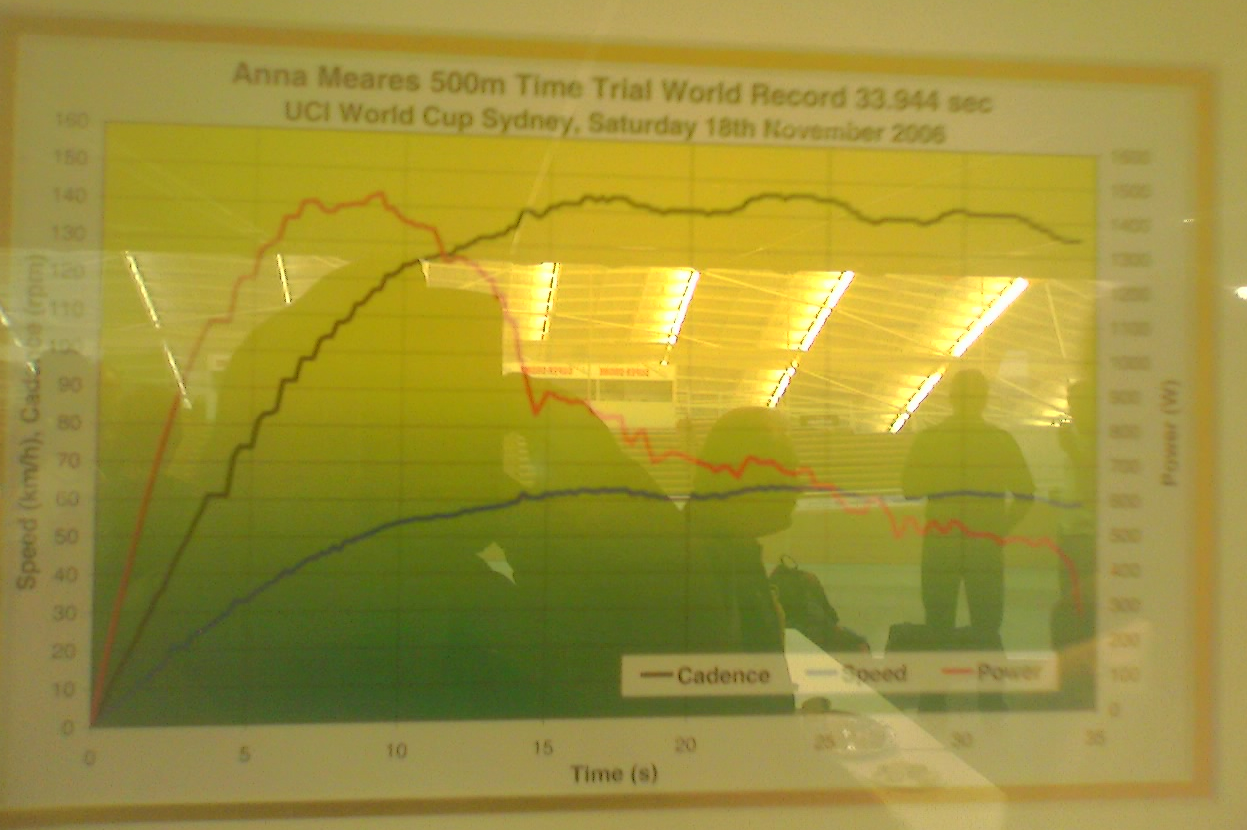 We can learn a lot from how much speed is maintained (or how quickly it decays) after it hits peak. Ie: the power required to slowly decelerate is much less than that which is required to hold constant speed, timing where we hit peak speed in a flying 200 is even more important than we've been thinking it was. (later is better!) - averages are misleading at best when it comes to analyzing sprint performance with power meter software. Have a look at Anna's data from her old world record. Look at the power put out while speed (slowly) decays. Remember KE = 1/2 m.v^2. Which is to say, momentum matters.
Female sprinters are a long term project - making them strong is a priority for their success in the long term. I am not alone in thinking this. Those of you who are female reading this - if you're not already - GET STRONG and be prepared for it to take a long time to happen. Anna spent 10 years getting strong. It's paying off now in spades. She spent her junior days being kicked in the arse by her sister, but she kept on getting strong and look at her now. Junior stars don't always become senior stars, the quick route to success isn't necessarily the best for long term development, ESPECIALLY for girls, ESPECIALLY where the rules are such that strong kids get handicapped by small gears. (we all know my rant on that!)
Get strong, go fast. Simple!
2012-04-01
2011-08-06
Why masters matter
For the future of sprint cycling, we need to get masters sprinting
When I was a little kid, my dad told me about when he swam (he was very good, broke Australian records, swam world-class times) and played rugby. These things had a lasting impression on me. I swam as a kid, and played rugby (union, of course ... real rugby!), from pretty-much as soon as I could. What our parents do, sports-wise, many of us follow. For example, Shane Perkins, current world champion in the keirin, his father raced track and was no bunny. Shane is by no means an isolated example. Most of the sprinters we see have been inspired to race by their parents.
Not all of them, of course, follow in their parents footsteps so if that was all we relied on for new blood, eventually the pool would run dry. How do we find new juniors who want to sprint? One way is to get parents to have a go. A recent example is Emily Apolito, her dad took up track cycling as a master when she was around 9 or 10 years old, she saw how much he enjoyed it and she gave it a go and is now a very promising junior track sprinter. Think also of Will and Bridge Thomas, inspired by their father, I can go on, there are many juniors who started up after their parents had a go, who's parents maybe weren't Olympians like Daryl Perkins, maybe they started later in life but they found that they loved it and their enthusiasm rubbed off onto their kids.
So masters matter, not just because they make good guineapigs for coaches to test new methods on(!) but also because they bring with them their families, who grow the sport as juniors, starting off at ages young enough that their potential can be realised. Masters are in it for fun, but they bring so much more than just an entry fee to a race. We must encourage and support them.
2011-07-24
Adelaide again
So here I am in Adelaide for another week
I've been very lucky in this sprint coaching caper. Right from the start. So here I am in Adelaide again, after a weekend's assisting Hilton with the Vic VIS and TID kids at a sprint camp. Now I'm spending this week (I'm here for the first week of a three week junior worlds preparation camp) with Sean Eadie, assisting him as much as I can, working on The Book some more. Amazing opportunity to learn and develop, and hopefully be a tiny bit useful to Sean for the week too.
The water here still sucks, and finding an open supermarket on a weekend is a challenge, but that's Adelaide for you!
The weekend's racing was good - everyone learned a lot and developed skills and confidence. The format was similar to the SSS, which as we know, works!
2011-07-13
110km
is 440
Laps of DISC yesterday, on the CBF250 ... Motorpacing doing 250m MAC's. Can anyone say "bloody cold"?!
2011-06-30
A busy month, July
I'll be all over the place!
July 2011, it's going to be busy. I'm going to Adelaide with the NTID and VIS kids on the 22nd for a sprint race meeting for J17's and J19's and then staying on for a week to assist/learn/get in the way with the pre Junior Worlds camp. The camp is three weeks long and takes the kids going to Moscow from the race meeting on the 23rd and 24th through 'til their departure to Moscow. I've been given the opportunity to stay with them for the first week and assist Sean Eadie. Along the way hopefully I'll get a lot of learning done. I'm looking forward to it, but I will be away from home for a week and will miss a couple of our winter DISC sessions.
In actual fact, I'm probably going to miss almost all the DISC sessions through July, on the 16th and 17th I'm (assuming it goes ahead) doing a whitewater rescue course. So I will probably miss that weekend also, and this coming Sunday I can't make it either. I've written a program that the guys can do without needing much guidance. Nathan's going to run this Sunday, I'll work something out for the others that I can't make. Ergo anyone?! Nah ... I didn't think so! Anyway, it's going to be hectic, this July.
I do have heaps of reading to do. I believe that any good coach needs to read widely and understand a lot of "stuff", so one of my current reads is a textbook on exercise physiology. Things are going well in the 'Haus, I lifted an equal PB deadlift yesterday (and can feel it today .. stairs .. urgh!), power's been down a bit on the bike for the last couple of sessions, but I think that'll come good soon. the other sprint squad people and assorted ring ins are all lifting well and their numbers are getting better on the track too. It's all good!
Oh, and we now have aboc Sprint Squad ploarfleece beanies. Perfect to keep your bonce warm at DISC or spin this winter. All the cool kids have one .. 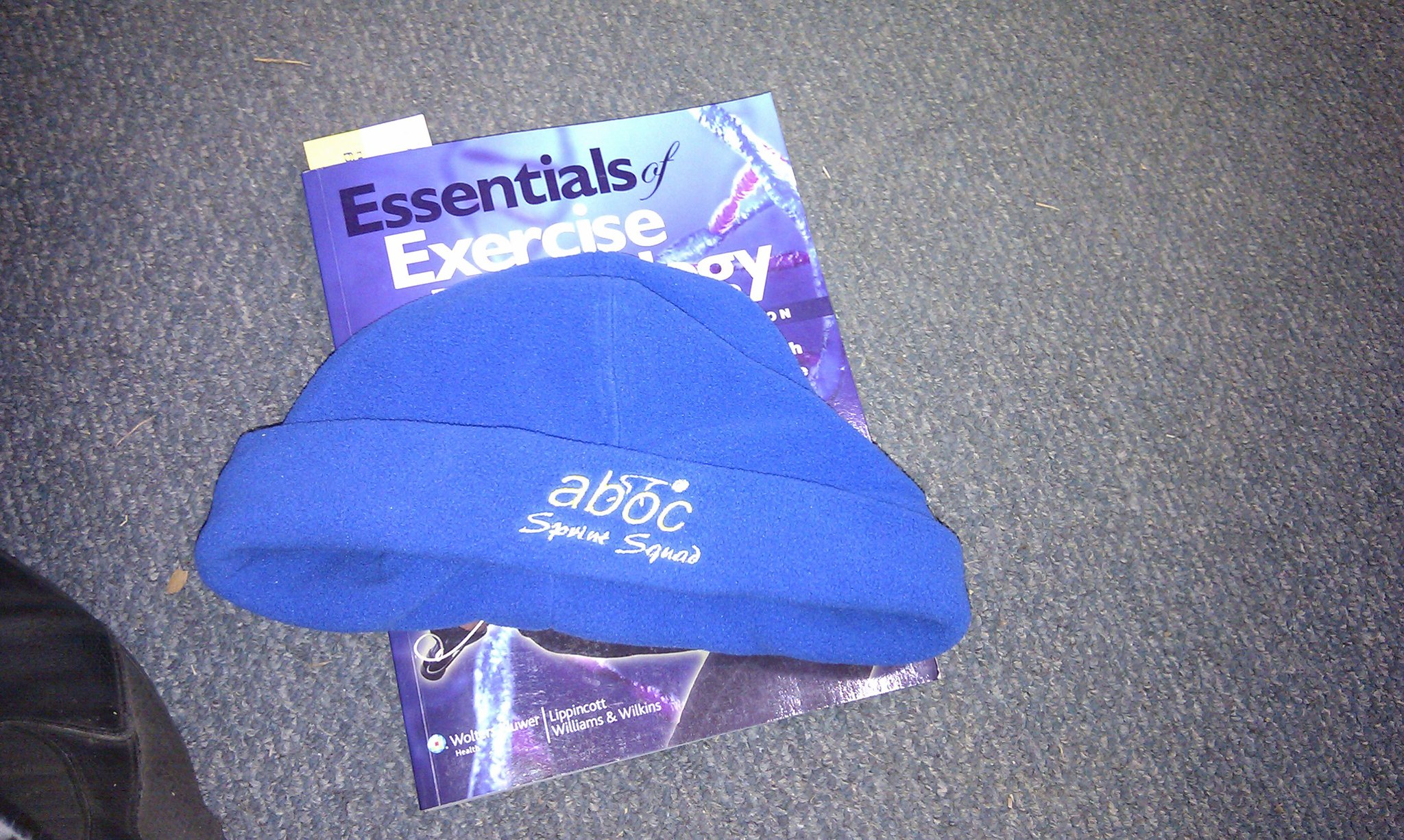
$20 and you can have one too!
2011-06-12
J17 to J19 - ouch
It's a really big step ...
For those of you who don't know, here in Australia juniors are limited in the gears that they can use. Under 15s are restricted to no greater than 6 meters of rollout (~76") and under 17s to 6.5m (~82"). Under 19's are, to all intents, unrestricted.
This is not a rule without its detractors. It is my understanding that the rule is designed for a couple of reasons - firstly, to protect the kids from hurting their knees and secondly to level the playing field to encourage and support participation. It may also be designed to teach the kids to spin high revs (how else can you go fast on a little gear?!).
There are some consequences of this rule which I think (and I am not alone here, it was discussed at a recent sprint coaching forum at the Junior Aussies and my voice was not the only one) are inhibiting the development of some potential elite athletes.
The rule as it stands means that J15 and J17 sprinters have to be able to rev to very high cadences - we're talking in excess of 160rpm for the boys, for the girls it's around 150rpm to be competitive nationally. In elite level senior competition, that is not a requirement and stronger guys who can push bigger gears prosper with peak cadences nowdays around 145-150rpm for the men. But the rule discriminates against the stronger kids in favour of the super-spinners. The stronger kids can create greater force (torque) and potentially greater power, but if they're limited by cadence they don't get to benefit from this strength as much as they should be able to. We don't handicap the big kids in athletics, football or any other sport. We don't tell the big kids in football that they're not allowed to jump higher than the littler kids to win the ball or tell them not to kick a goal from 45 metres out because that's not fair to the littler kids who can't do it yet.
The super-spinners then, at the end of J17's (and the bleed through of this into J19's) run into the stronger riders and it's a big shock. This is when we lose a lot of them. There's other things going on too at that age, school gets harder, alcohol, cars, relationships and so on become bigger deals, but I suspect that the transition to the open playing field from the shelter of the J17 and below gearing rule is brutally hard and breaks the spirit of the super-spinners, who may have already broken the spirit of the stronger and heavier kids who may well be better in unrestricted competition but got sick of being beaten by the kids who the rules favour when they were younger. This ultimatly doesn't help the super-spinners either because they're playing on a field that's made to suit them, but it's going to change when they get older and they may be so addicted to winning by revving that they can't cope emotionally when it's time to play with the big kids, especially if they're convinced through their own limited experience that all they need is revs and they'll win everything.
So if this is a problem, what should we do about it? I don't buy into the "save their knees" issue - I'm yet to see any evidence in support of it. We overgear the kids all the time in training and I've never seen a problem. Even on big gears the peak torque the kids can put out is no-where near what they'd do on the school playground jumping on a football field or doing gymnastics or anything else we think nothing of all the time. Assuming that's the case, I think the rule should change. I think J17's, at least, should be allowed to ride bigger gears. Because you can ride a bigger gear doesn't mean you have to, and I know at least one junior who is so amazingly quick on tiny gears that they would not go up a gear even if they had the choice. It would be a rider's choice to use a bigger gear and a smart rider wouild choose the gear that worked best for them, just like they get to do in J19's and above. The transition to J19 would be less harsh for those who were thinking ahead to it, especially the girls, who need to get strong early because otherwise it's very hard for them to get strength later in life.
2011-05-19
Racing tonight!
Not quite what I had in mind, but they are sprints ...
aboc, ie: me, is sponsoring this; Blackburn's running five sprint nights at DISC over "winter". The rough program is this :
Flying 200 for grading.
1.5 lap dashes (4 riders at a time I think)
Team sprints (graded by your f200, not able to nominate your own team - this is still being 'discussed', I am not happy about not being able to nominate my own team or starting order). These at least will be no longer than 3 laps (they originally wanted 4 laps, huh? What 'team sprint' has 4 laps? And then expects the poor bugger that rode 4th to race again in 15 minutes?!)
1k handicap, held start, no push (The kilo is dead, no-one trains for it anymore ... why is this in the program? To embarras sprinters?)
Scratch races for the leftovers
If there's enough time, keirins to finish.
I will only be racing the F200, team sprint (assuming an acceptable team and I'm lead rider) and the keirin, assuming the program doesn't have to be cut short because there's too much going on. The other stuff is just silly and I'm not doing it.
Those of you who were at the last round of the SSS will know that the above is not what I planned, but since I'm not running this, it is what it is and it's better than a night of scratch, points, h'cap and/or motorpaces. It's a start. If it's a bit successful, we can lobby to make it different for later rounds or next year etc.
So that's tonight's festivities at DISC.
I've been pretty busy with the NTID squad and helping Hilton for the last few weeks, as well as coaching in the 'Haus a lot, running Spin, Sunday DISC sessions, and that's my excuse for not writing much here in May. I have loads ot writing to do for The Book too ... lots of gaps to fill!
2011-05-01
The pointy end
Why everyone defaults to enduro
How do most people get started in a sport? Usually it's at school, or you get invited by a few friends to join a team etc. Most of the 'sharp' sports (Olympic or other elite level, football, criocket etc) get their talent young, at schools or by blind luck and co-incidence. Then there's everyone else who maybe missed that boat.
Why did you start riding your bike? Most of the people I speak to (and after almost a decade of coaching, that's quite a large sample) started out wanting to get fit. They're mostly older (not juniors, most of my coaching clients have been masters age or mid 20's starters), mostly got a bike, went off and rode Beach Road, did maybe a few things like the Bay in a Day or the Alpine Classic (or wanted to but didn't think they could). They saw Glenvale, got interested and had a go (it's easy to start with crits). Kids do it a bit differently, maybe it's a school around the bay program, or they pick it up from their parents, who maybe raced or are racing.
What do they do? Endurance racing. It's all endurance. Crits, 90% of track racing (certainly Blackburn's track program is endurance based, I expect most other clubs do the same or similar), road racing ... everyone's doing endurance.
The same thing with running, there may be a few sprint races at schools and a couple of the fast kids go off and get popped into little aths or similar if they're lucky enough to have a PE teacher who notices and is well enough connected to get them started, but everyone does the cross-country run, adults train for half marathons or triathalons. Who trains for sprints? Who even thinks they could? Very few people, in my experience.
I want to change this. I want sprint to be big. I want YOU to have a go, and if you've got kids, to have your kids exposed to sprint. It's the pointy end of the sport and it is not inaccessable. We're making more sprint races, we run a sprint series, we want YOU to have a go.
2010-11-28
The Oceanias
International competition, oh my
5 days in an insulated-from-reality-bubble. Wake up, go to velodrome (via shops) - assist Hilton, assist Sean Eadie, push riders, council riders, congratulate/commiserate riders. 12-14 hours later, go back to motel, take 3 hours to unwire enough to get some sleep, repeat ...
Wow.
My first taste of real international elite competition and I'm hooked. Sprint camp was one thing, this was a step up. In a way it was more of the same, we had a lot more support - mechanics (Ian, Gary, Tony, thank you!), to look after all the bikes, wheel changes etc, support staff to handle all the odd jobs (Josh, Emily, thankyou! you guys were great). Hilton ran the warmups from his throne in the pits and we both looked after the riders during racing. We had a squad of 7 core riders and a few we helped out, at some points we were over-supplied with people to help, at other times there wasn't enough of us. We did good things, we made mistakes, we learned. We learned and we learned ..
Our sprint guys did very well, we got some medals to bring home and everyone learned a lot. A highlight was seeing Imogen and Taylah racing in the Keirin final with Anna Meares (and Immy's ride to qualify for it, glued to Anna's wheel!), Nathan's storming first lap in his team sprint and Jaron's jammed in the middle of a 4 wide sandwich in the J19 keirin final. As a first year senior Nath was always going to be behind the 8 ball, but he rode well and has a good picture now of where he has to be (and he can be!).
Some talent to watch out for, a Kiwi girl, Stephanie McKenzie. She won the J19 500m and the sprint, and her 500m start was the best 500m start I've ever seen from a girl. Girl's don't rattle the start gate, Steph did .. Wow. Watch for this one in the not too distant future. Guess what her background is? Gymnastics (explosive power and strength) and Olympic weightlifting. Is there something in this "get the girls strong" idea after all? Anna didn't ride the 500, but any time you get to see her racing is great, she won the sprint and the keirin in the style that we've come to expect. She's a class above the rest at the moment. The world cup will be interesting indeed.
I'm not going to fill this page with details, 5 days of living and working in a surreal bubble has fried my head and I'm still catching up on sleep, but suffice to say it was an amazing experience and a lot of good will come of it. I have a tentative agreement now to be able to do over to the AIS for a couple of weeks and hold Gary West's stop watches etc (learning, learning ...) at a date to be determined and Sean Eadie and I did a little work on The Book. Hilts and Josh (NTID manager) and I had a meeting about how my work with Hilts is going and I got some good constructive critism, there's a few things I need to really concentrate on which is good.
In the mean time, It's round 3 this coming Sunday. Hrm, I think I've been on a track bike once since round 2? If I'm lucky ... I don't think I'll be riding any PB's! heh ...
2010-11-21
Metros
A huge weekend
Last week I had a bit of a cold, which meant I stayed away from the NTID training session on Wednesday (didn't want to give anyone my bugs) but by Thursday I felt ok. By Friday, my voice was getting pretty croaky, and by Saturday I'd almost totally lost my voice. Now, I'm not a shouter like Hilton, but I do shout at my riders, and every attempt I made to shout encouragement was a feeble squeak! Not ideal for coaching at a championship ... Quite amusing for everyone there though, I'm sure!
The Metros ...
It was a hectic weekend, I had the aboc'ers to look after as well as the VIS and NTID riders. Saturday morning was pursuits and I didn't have too much work to do then, I did walk the line for a couple of riders, including aboc'er Cam Woolcock who got himself a medal, Liz Randall (also a medal, gold!) and Emy Huntsman (NTID endurance) - I made a mistake while giving Emy her pacing, a bad one that may have cost her a gold medal. I need more practice if I'm to do this again at a championship - In my defence, it's not what I'm concentrating on, but I probably shouldn't have done it for Emy. Emy, if you're reading this, again, I'm sorry.
In the afternoon it was time trial time (sprint!) - the aboc Sprint Squad was there in force, Dino, Emily, James, Chris, Cam, Yasmin. All of them rode well, we got a couple of gold medals, a silver or two and a load of PBs on a slow day (thick air and cold). The NTID and VIS girls I was also looking after (although mainly just carrying bikes, Hilton had the floor) rode solid races and as you'd expect, won or placed in everything. That sounds like a big deal, but it is what we expect. The NTID and VIS program cherry picks the best talent, if they don't win everything we're not doing our job.
Sunday ... Sunday's the biggie for me. I love match sprinting. Also coaching the 500 (Emily & Yas, don't worry, the 500 is a very high priority!) but match sprinting stuff is where there's actually something to do on race day, the TT's are all won in the weeks and months leading up to them from the point of view of a coach, match sprinting has a lot more on the spot coach involvement, at junior level in particular. For the TT, all a coach has to do is make sure the rider is at the right brain-space at the start and warmed up well. Match sprinting is another level.
Hilton was going to be busy loading vans to take over to Adelaide, so I was left on the floor to run the show for all the guys. I think I had about 15 or more riders in my care : Dino, Emily, Ruby, Courtney, Madeline, Adele, Caitlin, Yasmin, Stuart (V-Train!), Clint, Emerson, Jacob, Luke, James, Chris. I think that's it? Anyway, Hilts had the NTID and VIS guys do their warmup, I had the aboc'er do theirs (different! but all coaches do things differently).
Then things got messy. It started when the organisers decided (but didn't tell us) that they'd changed the flying 200 from 3 laps to 2. This is a big deal for the 15's and up, they train for 3 laps and last minute changes like this are simply not acceptable, it stuffs up their timing. We made a fuss about it and Hilts managed to get them to change it back for the 19's and above, but it was unfair and caused a lot of angst and slow times by our riders, save for Courtney, who unofficially (the electronic timing didn't work ... I'm not joking, it was a bloody disaster) smashed the JW15 Australian record.
Then some of the races got dropped from the program. I'm not going to mince with words, this is unacceptable. The kids that show up to race care about their racing. They train and they work hard. To have their races chopped from the program to save a few minutes is not on. I'm still very angry about this. One of my guys was heartbroken and there was nothing I could do about it.
After that, the rest of the day went well. My job was to council the guys on tactical decisions and hold them on the line. It looks like I have a conflict of interest when I'm involved in coaching multiple riders who are racing eachother, but I'm careful not to tell one rider anything confidential about the other and I think they all trust me to be ethical in this area - it's important that they do, and that I am 100% on this. If any of you read this, I assure you I will never tell your competion anything about you and I will never tell you anything you don't already know about them either. My main job while in the thick of it is to get the riders feeling confident and motivated (a challenge indeed sometimes!) and to encourage them to be assertive and aggressive on the track, to make their move and commit to it. The older, more experienced sprinters need less tactical guidance and I mostly left them to themselves except to check if they needed anything and give them an ear to talk to if they needed it.
Again, everyone rode well and the NTID/VIS combo swept the field, as they should. My aboc'er did well, with another bootload of medals and a lot of very valuable experience gained for the Vic titles coming up soon.
At the end of the day, Speed is the best tactic. 90% of the races will go to the faster rider, but the thrill is in getting a slower rider over the line first. It happens, and we did it a few times on Sunday.
Leanne Cole got some good photos, go have a look.
Phew .. that's done. I'm off to the Oceanias tomorrow, back on Sunday. More of the same. Bring it on!


