ranting
2014-03-03
juniors, flying 200's, oh my
Lots of room for improvement
At the Aussies, we saw the best under 15's, or at least, the best that came through the state teams. We saw them ride flying 200's and make poor pacing choices. Read this article on it that I wrote.
2013-12-11
How to not be an arse
How a prominent Melbourne bike shop got in hot water
Many of you may be aware, a prominent and very visable Melbourne bike shop got in trouble last week for posting online some topless photos from an event they had at their shop. A lot of fuss has been made about it, I think justifiable. What this shop did was pretty damn stupid at best, but to make it worse, they then posted online a pathetic justification of it. It blew up all over Melbourne, as well it may have been expected to. It was a wrong thing for them to have done, and their "management" of the issue just made it worse. If they'd said "sorry, we did a dumb thing and have learned not to do it again" and left it at that, all would probably have been forgiven by most of us.
Given the unrepentent behaviour of the shop owner after this all blew up, a complaint was raised to the shop's major supplier, and they, to their credit, did the right thing. The suppliers brand will survive untarnished, but the shop? The guy who runs it has shown his true colours. There are many, many bike shops in Melboune that respect their customers and female cyclists and who stock all the same stuff as this mob. You have choices with regards to who you take your business to. Please choose wisely.
Now we can all get back to training and racing our bikes!
2013-11-20
Cargo Cult coaching?
Why do we do things the way we do?
http://scienceblogs.com/catdynamics/2013/08/15/cargo-cult-administration/
http://neurotheory.columbia.edu/~ken/cargo_cult.html
Interesting, it applies to a lot of fields (all of them?!) - People do things because they've seen them done, not necessarily becaise they understand the reasons why or how they work.
As a coach, it's important not just to "do" but also to understand why we do what we do. It's ok to copy/learn from other programs, disciplines and coaches, but ONLY if we know why and how - or at least, have some understanding of the method. Not everything in coaching is clear cut and often the "evidence base" is pretty flimsy, but we must strive towards greater understanding of what we do, why and how it works (or doesn't!).
Coaches are not scientists, we're engineers. We apply the best available science, mix in some gut feeling and experience where the science is lacking, and run with it to build bridges. We need to understand science much as an engineer does, we have to be able to speak the langauage and ask the right questions (see this : http://startingstrength.com/index.php/site/exercise_science_presentation_2013_part_i as an example of how to read and question ex phys papers). We're not scientists, but we have to think like them sometimes, and call them if they're making mistakes. It happens, a lot. A lot more than we'd like!
(I'm a big Feynman fan, I have a few of his books, the guy was a once in a lifetime genius)
2013-10-01
Even when they have it all
They want more!
Minor rant time.
Sprint is starved for competition. Famished. We get next to nothing. Until the NJTS came along (and I, and a few other coaches, lobbied like mad to get more sprint-ish races included in it, thank you Max Stevens for listening) if you were a sprinter as a junior, you get two, maybe three or four if you're in Melbourne, chances a year to compete. Club championships, state titles, metro/country/Vic Track Cup and nationals if you made it that far. I'm going to take credit for my Summer Sprint Series as well, but that's only club stuff and we have 5 rounds a year. So maybe, if you're in Melbourne, not including NJTS, you can, at most, have 9 chances to race sprints per year. Nine. Count them.
Enduros - HUNDREDS! Clubs fall over themselves to offer junior tours, there's track racing two to three times a week or more for enduros, more road races, crits and other stuff than I can count. Hundreds of opportunities to race. The "sprint" races at the NJTS are not match sprints, they're short (2 laps) events and baby keirins that enduros can be competitive in. The NJTS gives us (sprint coaches and talent ID people) a chance to see potential sprinters if they pop up from the default endurance setting that all clubs impose and maybe we get a chance to rescue these kids if we're lucky. It gives the kids born with some sprint talent a chance to actually stand out in some racing before they give up and go play footy because they're all fast twitch and can't hang on up some hill somewhere because that's not how they're made.
The NJTS program is weighted to the advantage of the sprinter? Take a step back and look at the big picture. Our sport is so massively, overwhelmingly biased to endurance that the suggestion is absurd.
2013-09-25
Finding the girls
Success should not be by accident
Over the last few weeks I've had some time to think(!) and also some interesting discussions with parents, kids, fellow coaches etc on the topic of finding more girls and getting them racing. In my case, sprint, but in general as well.
The few girls we have (who, lucky, are very talented) have been found mostly by accident or it's been a struggle for them to get involved. I've had parents tell me that they've been to come and try days at DISC then mostly given a runaround when they expressed interest in going further by calling Cycling Victoria. This is not CV's fault, the structure as it stands at the moment is that CV has to tell parents (or adults!) to "call your local club". This can be quite a hit and miss approach, some clubs have better responses than others and it's then down to volunteers who may or may not have female cyclists as priorities. So we miss some kids. I suspect we miss a lot of kids. If we want a high peak and consistant international success, it is fundamental that we have a broad talent base. We can't just bumble along hoping that volunteers will have the time and the motivation to do right by people who have already expressed an interest.
In retail, if someone walks into a shop, the battle is 90% won. Sales people are just finishing it off. We need to learn from this. If a kid goes to a come & try day, or schools racing, or HPV racing; they're already interested, they've walked into the shop. All we need to do is make eye contact and talk to them. But to do that, we need to be there. If you walk into a shop and there's no staff to help you, or if there is, they ignore you or wait for you to come to them, you're much more likely to walk out and go somewhere else. The same applies to us and recruiting junior female cyclists (and male, but there's so many more of them that it's not such a critical issue). I think we need a visable, friendly club representative, preferably female (because CV can't do it, politically and resourcefully) at every C&T at DISC, and where possible, at school cycling championships and major HPV events. We shouldn't get lucky every now and then, we should structure for success. It needs to be deliberate and planned and resourced. We are letting kids slip through our fingers. We need to stop it happening.
Building development squads for kids already in the sport is the easy, sexy thing to do*. Converting the kids who have shown an interest into kids who will have a go is the vital part. Not sexy, no big public relations coup for sponsors, but MUCH more important to the long term success of our sport locally and internationally.
* - not that it's not valuable, it is, but it's not going to get girls started in the first place.
2013-09-17
What it takes
So YOU can race!
http://cyclingtips.com.au/2013/09/whats-involved-in-organising-a-bike-race/
Remember, whenever you race, ALWAYS take the time to thank any vollies you see running it. They've donated their time so you can have fun. Oh, and BE COURTIOUS even if you get DQ'd for something. Play nice, or no racey-racey ...
2013-07-08
Standards, safety, syllabus
Making Blackburn's Friday night DISC session safe and efficient
At present there's no standard for riders who lob up on Friday nights at the Blackburn DISC sessions I'm running for the club as the senior coach present. This is a problem, there's a culture of "just show up, you'll be right". This is NOT acceptable - we've had a number of close calls and some crashes resulting in injury due to this problem.
I don't whinge about things, I fix them. Here's a fix. A set of skills a rider must demonstrate before they come :
Skills required to attend Friday DISC sessions run by Blackburn Cycling Club
Ride sprinters lane solo at ~30km/h
Ride blue line solo at ~30-35km/h
Ride the fence solo at ~35-40km/h
Competently display 1/4 lap RAC (Rolling acceleration/Powerjump)
Competently display solo flying 100
Competently display held start and gate start
Competently roll turns in a bunch at 30km/h
Follow motorbike at 50cm distance or closer
Follow motorbike for motorbike acceleration
Roll turns behind motorbike
Roll turns with motorbike
Change own gears
Accelerate out of saddle in bends
On its own, that's not enough. Here's a rough syllabus to teach these skills :
Progression for attendance at DISC sessions
Eash session is ~30 mins, small groups – no more than 4 riders per coach, coach to ride with riders as a demonstration, leader, pacesetter etc
Anywhere
Change gears
Understand appropriate equipment for DISC – tyre selection, range of gears, warm clothes for winter.
Recommended tyres for DISC : Vittoria Rubino Pro-lite, Vittoria Rubino Pista
Expressly not permitted at DISC : Michellin Pro-*-race, Michellin Lithium.
Default warmup gear 82" (49x16)
At BBN on 82" (49x16) or relevant junior gear if J15 or younger
Session 1
Ride sprinters lane 30km/h 82" gear (49x16)
Ride blue line 30km/h
roll turns in small group
Session 2
Held start
Gate start
1/4 lap RAC15 (powerjump)
Accelerate out of saddle in bend
Flying 100
Session 3 :
Motorpace 50cm from motorbike
Roll turns behind motorbike
MAC
Roll turns with motorbike
At DISC on 82" (49x16) or relevant junior gear if J15 or younger
Session 1 :
Ride the sprinters lane at 30km/h
Ride the blue line at 35km/h
Roll turns in small group
Session 2 :
Consolidate rolling turns in small group
1/4 lap RAC15
Accelerate out of saddle in bend
Ride the fence at 35-40km/h
Flying 100
Session 3 :
Motorpace 50cm behind motorbike
Roll turns behind motorbike
Roll turns with motorbike
MAC
Let it be known that I am volunteering to teach this, but NOT AT DISC ON FRIDAYS DURING THE SESSION (6:30-9:30pm).
2013-01-23
Gears, again...
What the rest of the world does
In the UK :
youth A u16..6.93m - ~7m, ~same as us, 1 year offset younger kids
youth B u14..6.45m - bigger than us
youth C u12..6.05m - bigger than us
youth D u10..5.40m - ~same
youth E u8..5.10m - do we have U8's?!
They're not falling apart, in fact, Le Poms seem to do pretty well ...
In the US (not so much a powerhouse anymore, but interesting all the same) :
17-18: Unrestricted
15-16: 6.78 meters (22'3")(48x15)
13-14: 6.36 meters (20'10.5")(48x16)
10-12: 6.00 meters (19’8”)(48x17)
For Juniors 16 and under who are competing in Championship team sprint, team pursuit, keirin, or Madison the 17-18 (unrestricted) gear limit applies.
I don't have the rules for other countries yet, watch this space ..
2013-01-20
Big gears, big fears?
Has the world imploded?
Not everyone's a fan of the 7m rollout for J17's. I've gone on to discuss this in the past. We now have our first lot of in competition times from Vic titles to look at. So let's have a look. I'm going to just look at sprint, I am not interested in the pursuits!
This year :
Event 3: JW17 Time Trial
2 Laps 500m Final - STANDINGS
| 1. | 32 | Brook RAMSHAW (CAR) | 38.735 | |||
| 2. | 31 | Chloe BAGGS (BBN) | 39.023 | +0.28 | ||
| 3. | 33 | Brit JACKSON (BBN) | 39.145 | +0.41 | ||
| 4. | 35 | Jordyn HASSETT (BBN) | 40.033 | +1.29 | ||
| 5. | 37 | Emily DUNK (BWK) | 41.310 | +2.57 | ||
| 6. | 36 | Jamie GOODING (BBN) | 41.909 | +3.17 | ||
| 7. | 41 | Freya WICKENDEN (CAR) | 42.000 | +3.26 | ||
| 8. | 34 | Greta CURRAN (BWK) | 42.063 | +3.32 | ||
| 9. | 38 | Madison FITZGERALD (BBN) | 42.637 | +3.90 |
No new records. Reasonably close times.
Compare to last year
Courtney FIELD(CAR) 38.195
Emily APOLITO(BBN) 39.256 +1.06
Chloe BAGGS(BBN) 39.656 +1.46
Emma BILSTON(B-S) 40.629 +2.43
Zoe NICHOLSON(ART) 41.872 +3.67
Nicole CLARK(WNG) 44.980 +6.78
Rebecca THOMSON(LAV) 45.568 +7.37
Apart from the outlier (Courtney), they're pretty close. A little faster with the bigger gears, but there's too much variation in te size of the girls fields and the quality of them to make any judgements yet. There's a lot of depth (relatively) in JW17 this year.
And the F200 :
Event 15: JW17 Sprint Qualifying
Flying 200 Top 8 to Quarter Finals
| 1. | 31 | Chloe BAGGS (BBN) | 12.737 | |||
| 2. | 33 | Brit JACKSON (BBN) | 13.046 | +0.30 | ||
| 3. | 32 | Brook RAMSHAW (CAR) | 13.128 | +0.39 | ||
| 4. | 35 | Jordyn HASSETT (BBN) | 13.373 | +0.63 | ||
| 5. | 34 | Greta CURRAN (BWK) | 13.512 | +0.77 | ||
| 6. | 41 | Freya WICKENDEN (CAR) | 14.029 | +1.29 | ||
| 7. | 37 | Emily DUNK (BWK) | 14.193 | +1.45 | ||
| 8. | 36 | Jamie GOODING (BBN) | 14.195 | +1.45 |
CF last year :
Courtney FIELD(CAR) 12.466
Emily APOLITO(BBN) 13.308 +0.84
Zoe NICHOLSON (ART) 14.670 +2.20
Rebecca THOMSON(LAV) 15.109 +2.64
Here we see some bigger differences - again, if we ignore Courtney as an outlier, the top three girls rode significantly faster this year. For the girls this isn't a suprise in the F200, they can wind up the gear, rather than have to accelerate it from a standing start (and most of the girls are not very strong, I don't think many of them lift), so I'd expect to see bigger changes here. What we are seeing is greater density at the top end. The girls field in 2011-2012 was tiny though, so the sample size is too small to draw any conclusions from, except that we have more JW17's racing sprint this year and that's a really good thing, there's also no (that I have seen) dead bodies on the floor. The horror of allowing 14 and 15 year olds to rev a little lower has not killed anyone. If anything, it's leveling the playing field a little, the mashers can keep up with the hummingbirds. AMAZING!
Where do we have depth? The boys. This is where we don't tend to see outliers so much because the talent pool is much bigger.
This year :
Event 4: JM17 Time Trial
2 Laps 500m Final - STANDINGS
| 1. | 4 | Gary RAMSHAW (CAR) | 34.323 | |||
| 2. | 1 | Ryan SCHILT (BWK) | 34.592 | +0.26 | ||
| 3. | 2 | David KOROKNAI (CAR) | 34.852 | +0.52 | ||
| 4. | 7 | Stephen ELLUL (BBN) | 35.144 | +0.82 | ||
| 5. | 6 | Thomas MCFARLANE (LGA) | 35.699 | +1.37 | ||
| 6. | 5 | Conor ROWLEY (BBN) | 35.929 | +1.60 | ||
| 7. | 3 | Kurt SANTAGADA (BBN) | 36.556 | +2.23 | ||
| 8. | 13 | Kyle MUIR (BBN) | 36.626 | +2.30 | ||
| 9. | 11 | James TICKNER (CAR) | 36.915 | +2.59 | ||
| 10. | 8 | Caiden HULL (CAR) | 36.985 | +2.66 | ||
| 11. | 9 | Nicolas ABELS (BWK) | 37.483 | +3.16 | ||
| 12. | 12 | Tomarsh LOKI (WNG) | 37.853 | +3.53 | ||
| 13. | 14 | Ryan KILPATRICK (SHP) | 37.935 | +3.61 | ||
| 14. | 23 | Jarrod WILSON (BBN) | 38.223 | +3.90 | ||
| 15. | 16 | Hamish WEBBER (BBN) | 38.779 | +4.45 | ||
| 16. | 22 | Lachlan VAN DER VELDEN (CAR) | 38.970 | +4.64 | ||
| 17. | 21 | Sebastian PRESLEY (BBN) | 39.614 | +5.29 | ||
| 18. | 20 | Adam PAYKEL-SAMUEL (CAR) | 39.766 | +5.44 | ||
| 19. | 25 | Clancy LLOYD (LAV) | 39.847 | +5.52 | ||
| 20. | 15 | Jacob MUMFORD (BBN) | 39.910 | +5.58 | ||
| 21. | 19 | Indiana MICHEL (SHP) | 40.463 | +6.14 | ||
| 22. | 24 | Ian HERMAN (BWK) | 40.601 | +6.27 | ||
| 23. | 17 | Samuel BROWN (BWK) | 40.874 | +6.55 | ||
| 24. | 18 | Stephen DAMM (LAV) | 41.435 | +7.11 |
CF last year:
1 Jay CASTLES(SHP) 34.608
2 Mathew ROSS(CAR) 35.419
3 John COCHRANE(BBN) 35.484
4 James DANN(BBN) 35.600
5 Jack HICKEY(CAR) 35.775
6 Jerome BECHAZ(CAR) 36.075
7 Braeden DEAN(BGO) 36.142
8 Jordan STANNUS(CAR) 36.866
9 Angus LYONS(B-S) 37.349
10 Caiden HULL(CAR) 37.580
11 Thomas VERLEYS-DONK(CAR) 37.878
12 Pierce CONNOR(BBN) 38.381
13 Lucas HAMILTON(ART) 38.383
14 David KOROKNAI(CAR) 38.436
15 Jade MADDERN(CSL) 38.764
16 Angus FLOOD(BBN) 38.820
17 Jack WALK(WGL) 39.241
18 Steven CARROLL(PRS) 39.563
19 Nicolas ABELS(BWK) 39.679
20 Hamish HAYNES(SHP) 39.935
21 Ned EFE(CAR) 40.039
22 Tomarsh LOKI(WNG) 40.555
23 Michael STRINGER(BBN) 41.495
24 Jarrod WILSON(BBN) 42.294
25 Lex MUNOZ(CAR) 42.452
26 Stephen DAMM(LAV) 42.841
27 Jacob MUMFORD(BBN) 44.577
Quicker across the board. Not dramatically, but it's significant. No dead bodies.
In the F200, we're a little quicker, but interestlingly, a lot denser at the top end. I wonder if any of the kids can get into the 10's if we find any real outliers? Wouldn't that be amazing ...
Event 16: JM17 Sprint Qualifying
Flying 200 Top 8 to Quarter Finals
| 1. | 1 | Ryan SCHILT (BWK) | 11.543 | |||
| 2. | 2 | David KOROKNAI (CAR) | 11.627 | +0.08 | ||
| 3. | 4 | Gary RAMSHAW (CAR) | 11.651 | +0.10 | ||
| 4. | 7 | Stephen ELLUL (BBN) | 11.662 | +0.11 | ||
| 5. | 6 | Thomas MCFARLANE (LGA) | 11.785 | +0.24 | ||
| 6. | 9 | Nicolas ABELS (BWK) | 11.866 | +0.32 | ||
| 7. | 5 | Conor ROWLEY (BBN) | 12.019 | +0.47 | ||
| 8. | 13 | Kyle MUIR (BBN) | 12.152 | +0.60 | ||
| 9. | 11 | James TICKNER (CAR) | 12.176 | +0.63 | ||
| 10. | 14 | Ryan KILPATRICK (SHP) | 12.477 | +0.93 | ||
| 11. | 23 | Jarrod WILSON (BBN) | 12.480 | +0.93 | ||
| 12. | 16 | Hamish WEBBER (BBN) | 12.669 | +1.12 | ||
| 13. | 25 | Clancy LLOYD (LAV) | 13.066 | +1.52 | ||
| 14. | 22 | Lachlan VAN DER VELDEN (CAR) | 13.366 | +1.82 | ||
| 15. | 19 | Indiana MICHEL (SHP) | 13.410 | +1.86 |
Last year :
Jay CASTLES(SHP) 11.631
Jack HICKEY(CAR) 11.682
John COCHRANE(BBN) 11.733
James DANN(BBN) 11.780
Braeden DEAN(BGO) 11.809
Jerome BECHAZ(CAR) 12.154
Jordan STANNUS(CAR) 12.383
Thomas VERLEYS-DONK(CAR) 12.623
Lucas HAMILTON(ART) 12.659
Angus FLOOD(BBN) 12.791
Nicolas ABELS(BWK) 12.839
Hamish HAYNES(SHP) 13.038
Jade MADDERN(CSL) 13.546
Stephen ELLUL(BBN) 13.635
Jarrod WILSON(BBN) 14.136
Ian HERMAN(BWK) 15.915
Any conclusions to draw? Not yet, it's too early to tell and I have only done a very quick and cursory look at the times from two Vic titles and I haven't considered atmospheric conditions etc. We'll see what happens at the Aussies and also when this lot of J17's move up to J19's next year. Remember the whole aim is to make the J19 -> senior jump less of a killer, and that will take 3-4 years to show itself. So far, no dead bodies, no velodromes lined with corpses and we saw some really good, close racing on the weekend, in particular in the JW17's sprint and keirens.
2013-01-12
A decade of coaching!
aboc is 10 this year
Wow, it seems like only yesterday that I was working with Neil and Trevor Cameron as my first victims while I got my level 1. I still get to work with Neil sometimes! A decade of coaching ... It's been a lot of fun and an amazing journey, but I am still a grasshopper with MUCH to learn! Bring it on!
Oh, and Neil's lesson to everyone : Wear your gloves eh?
2012-10-11
Avoiding the slippery slope
How does doping start? It's cultural
Everyone wants to go faster, either in sprints, or boost their thresholds for those long, tedious bits before a sprint finish in an endurance race. One way to do this is to cheat, doping works. It's a fact. It works.
Culturally, how do we try and prevent it? For starters, we don't do what the Peaks coaching group have just done, they're now loudly flogging some magic concentrated beet juice as a miracle performance enhancer, but it's ok because it's natural or something. It's a supplement and it's not banned (yet, who knows if, like caffeine, it'll be a threshold thing, too much NO and you're busted), that's true, but it's the wrong thing to be doing (hey, I guess they want to make a buck, and they are the exclusive US distributor of one particular blend, all's fair, right?). No. Wrong. Wrong message.
"The nitrates in Beet It beet concentrate offer the athlete a competitive advantage, some studies showing up to 16% improvement in endurance! I noticed the difference with Beet It shots after my first use! It's a subtle ability to push harder for longer. Who doesn't want this!?!"
This is right when the fuss about Lance and doping is front page news. Seriously?!
2012-08-29
In defence of the new gear restrictions
Not everyone's happy
Earlier this week CA announced that J17 gear restrictions would be lifted to a 7.0 meter rollout, which is around 90 gear inches, it was to be lifted to 86" (6.75m), up from the previous limit of 82" (6.5m).
Many of you reading here know I am very much in favour of this, but not everyone is pleased. I hope to calm the storm a little, or at least provide some argument in favour. Note please that this is my opinion, and I am not representing any organisation except for aboc Cycle Coaching (me!) when I write this. Furthermore, I don't have any influence on the people that made the decision that I am aware of. I don't even know who they are.
Enough with the preamble ...
Firstly, the rule change does not mandate that every J17 rider ride 90". It means they are allowed to, which is not at all the same thing. J19's are allowed to ride up to 104" or something, they don't, because they usually can't. I work with J19's who can squat small cars and deadlift your fridge, full ... they're not anywhere near being able to rev out the J19 gear restriction yet,. and managing them through J17's is a challenge (be patient, your time will come, being restricted to 82" sucks, but next year ... repeat and hope the kid buys in to the argument).
If a J17 is a great revver, they will choose smaller gears, if they're a big, strong kid, they will push bigger gears. Up 'til now the rules have biased against strong kids and towards super-revvers, at least in sprint, which is where my attention is focused. I expect it's the same in enduro circles. Big, strong kids can't rev as fast as the hummingbirds (heavy legs, can't move 'em quite as quick, but they can accelerate!). We build kids up to be strong so that they can be competitive as J19's and seniors, and not spend another 6 years trying to get them strong enough, this is an even bigger task with girls than it is with boys - they put muscle on a lot more slowly than boys. One of the causes for the loss of elite sprinters after J19 is the almost insurmountable gulf between a J19 and a senior (hey, kid, race Perko, who is pushing 108" or more and Anna who is superstrong! good luck ...). I've interviewed a number of guys who've given it up after J19's and this is a common theme. They don't want to spend 5 or more years getting smacked before they're even at a level where they can keep up and not be embarrassed.
By better preparing J17's to use bigger gears, we hope to lift the standard in J19, and thus, make the transition to senior riders be less daunting. If J17's filters out a lot of the strong kids in favour of super spinners (which, at present, it does), that means J19's are in general, weaker than they could otherwise be as a population, and then less likely to manage the jump into senior ranks. There's loads of examples of this in sprint in recent memory, in particular in the girls, but also many of the boys have failed to make the jump past J19. This is for many reasons, but one is that the jump is too big for most of them to manage in a realistic timeframe.
Some of my colleagues have mentioned that by allowing J17's to push 90", that this will kill the sport and other hyperbole (and a half!), or that we shouldn't change a working formula (hey, it's NOT working! We bleed riders after J19, you haven't noticed?! Where are they all?). Nonsense. The current situation is that strong kids are held back (and they're often some of the best talents, so they go off and play some sport where their talent isn't nobbled), hummingbirds prosper and the less talented kids are off the back on 82". The only difference by allowing bigger gears is that the strong kids will be able to keep up with the hummingbirds. The less talented, or younger, or less developed kids will be off the back no matter what anyway. It happens now, it will continue to happen. I don't think much else will change. If it does, the rules can be changed again.
OR
And this is the rub. Many are suggesting that club racer kids will give it up because 90" is too big and they can't keep up, there'll be no tactical development etc etc. Here's the thing. At club level, clubs are free to introduce their own gear restrictions anyway. You want a race where no-one can push bigger than 82" - NO PROBLEM! Just put it in the race rules. Brunswick did this on Saturday, everyone was on 90" (magic number?!) and it was great. Close races, lots of skill and tactical development. GOOD! We had first year J19's (the ones I trained overgeared last year and got strong and who hated being forced to ride 82" in competition) keeping up with senior sprinters, which made for good training races. But, for opens, state and national championships, the talented kids should be allowed to display their physical talent. It may well keep them in the sport longer and help us find the next group of champions. State and National titles are not "every kid's a winner" races, they're championships and the best kids should be able to win them.
I'm sure there will be people who will cite examples of successful riders who came through our current system, they do exist, and this is good (look closely at their development path before you cite them though, some will surprise you at how they got into the system, Cadel rode MTB, Matthew Glaetzer was a pole vaulter and did not come through gear restricted juniors etc), but we can do better (we have to, everyone else is!) and we can't say everything is great because some physiological freaks have survived it, if they even came through it. Our rules and development programs should not be judged by the success of the very rare genetically gifted athletes that pop up, but rather by the health of the whole ecosystem.
Finally, the knee injury furphy. Where's the corpses? We train our guys overgeared ALL the time, putting out much greater torque and power numbers than anyone else in the state (wanna bet?! I have data ... ), I have not seen a single knee injury. Not one. If a kid isn't strong enough to push a gear (86, 90, whatever) they simply won't be able to push it. They can grind at 60rpm up a hill (that's ok ...) in a road race out at Eildon or the 1:20 etc already if they want or have to. Knee overuse injuries come from throwing kids at huge miles and on badly fitted bikes, not from pushing a gear that's too big for them.
So there you go. I don't think it will kill anything, I think it's for the long term good of developing better senior riders
2012-08-28
gears go up!
J17's can be strong!
Long have I ranted and railed ... and good news!
J17's are now allowed a 7.0m rollout (~90").
Excellent!
2012-07-24
Please, Minoura, give us our rollers back ...
An open letter to Minoura Japan
I have two sets, the VIS has heaps, the AIS, NSWIS, Cycing Vic and WAIS all own dozens of them. Hilton owns at least 4 sets, of the Minoura Action roller. Why these rollers in particular? They're not perfect, they have aluminium roller drums with 105mm diameter, which is good, but nasty plastic endcaps that fail with heavy use. The big plus for us is the way they fold up into a small space and they have a reliable, simple bag to transport them. I get to carry them around a lot, and the bag, and the trifoldability, is a BIG win. This is why just about every state track team has heaps of them. 105mm metal roller drums and great transportability. Got it?
Not that long ago they got discontinued. Why? I don't know, the replacement is the Moz roller, same trifold frame, but smaller 80mm plastic roller drums (BAD!) and a fancier bag that has a zip instead of a flap. This is bound to fail in our use-case. We move lots of these rollers (Hilts' van may have a floor lined with 16 sets of rollers when we travel to championships etc) and anything with a zipper is bound to fail.
So, Minoura, please re-release the Action rollers. If you want to make them better, replace the plastic roller endcaps with something more robust, but otherwise LEAVE THEM ALONE!
2012-07-02
A week in the life of
What I've been up to lately
I've been pretty busy of late... Last weekend (no, sorry, the weekend before, June 23 and 24) I was looking after a bunch of VIS/Sprint Academy sprinters* at the Perth Speed-Dome on a flying visit to race a Grand Prix and the Westral, we flew in to Perth on Saturday morning, drove to the velodrome, trained, back to a motel, dinner, sleep, back to velodrome for a full day's racing, packed and drove back to the airport and flew home. Phew! I was so tired when I got back to Tullamarine I couldn't see straight, thank you Jayne for rescuing me! If I'd have tried to drive home it would have been a dangerous trip indeed.
We've also, in conjunction with Blackburn, started running Friday night training sessions at DISC. So far they've had low attendances, but hopefully word will spread and we'll get more numbers - we run a sprint and enduro session, with each group getting roughly 20 minute time slices. It's a format that works well and I've been using it for years with our Sunday sessions, but the Friday nights we have the luxury of three hours, not two on Sundays. More time! Sundays are chugging along well, it's been pretty cold in at DISC but we're doing good quality work and the guys are going faster (when they attend regularly!). Our program is always published in advance on this website, and I am more than willing to entertain requests and suggestions for additions and alterations to the program.
Also the Tuesday evening Spin sessions at Blackburn are trundling along - we've had some huge nights and some quiet ones - if you're not coming, I'd really like to know why, it will help me to improve the sessions if I know why you're choosing to do something else.
So that's Friday and Sunday and Tuesday evenings locked away. What else? Wednesdays I'm at DISC doing the Victorian Sprint Group coaching, assisting Hilton Clarke, and he's away in the US for a holiday until the 16th of July, so that's Wednesdays from ~11am 'til 7:30pm or so. This also happens on Saturdays, from ~11:30 'til 5ish. Lock away Tues, Wed, Fri, Sat and Sun. Anything else? Oh, yeah, coaching and lifting in the Powerhaus gym on Mondays and Thursdays from ~3pm 'til 8 or so.
That's, ahh ... pretty busy!
So if I've been a bit slow in getting back to anyone with emails etc, now you know why! I have to set dates for next summer's Summer Sprint Series, urgh ... Calendars ... Clash. clash clash ... Keep an eye here for dates.
* - No, I am not employed by the VIS, I was sitting in as a Sprint Academy coach for Sean Eadie while he's in Italy with the seniors in the leadup to the Olympics
2012-06-13
2012-05-14
Being different
If we were doing the same as everyone else did, we'd get the same results
A brief point on my philosophy. Starting with something general :
If you do what everyone else does, you will never do better than them.
Caveat, genetic freaks will float to the top, sometimes coaches ride on the coat-tails of these freaks and take the credit for them, or use their success as proof that they know what they're doing, but the freaks will prosper almost no matter what, sometimes the freaks think how they did things was the only way, or the best way, and MAYBE it was, but they can't know that for sure, unless they have identical twins or clones to compare to, and that stuff went out with Nazi Germany ...
So?
Sometimes I discuss things that are challenging to many who sprint, coach sprint, or generally watch sprint. By challenging I mean different to what they do, or did, or think should be done in the preparation of sprinters.
I don't always implement what I discuss, this blog, and the book, are to a certain extent my musings as much as any sort of a "fact" or prescription. There isn't a "right" way to prepare sprinters, if there was, there'd be no room for improvement, everyone would be at the same level and things would stagnate, the guys with the right mix of ACTN3 would win all the time and things would be very boring. For what it's worth I have very little scope to implement much anyway, I don't write much of the programmes for the Victorian sprint group, I did have the responsibility (overseen by Hilts) to program for most of last year's J17's, but I didn't do anything too whacky, and certainly nothing Hilts didn't approve of. I help Hilton by riding the motorbike, carrying heavy things and generally getting underfoot, I don't lay any claim to being responsible for any part of his programme and I don't take any credit for his successes.
Martin Barras was very different to Gary West (in both incarnations), as was Charlie Walsh, as is Hilton, Sean Eadie, David Short, John Beasley, Clay Worthington and David Willmott, over the ditch Hamish Ferguson has something interesting to say which is quite challenging. They all have different methods, different uses of track, road and gym work. This is good - it means that hopefully different riders can have a chance to shop around to find the right coach for them. As an assistant to Hilts I know a fair bit about his program, but not all of it and certainly I don't have his intuition or decades of experience but I am learning a lot from the old master. I've had a lot of time to spend with Sean over the last couple of years and a little bit with Clay and Shorty, I've peered under the covers of their programmes too. We discuss, sometimes quite passionately, our ideas about training (that's what happens when a bunch of sprint coaches get together, we argue, discuss and rant, and it's great!). it's all different. We're all trying to improve on what has been done in the past, not just repeat it because that's how it's always been done or that's what everyone else is doing.
One thing is for sure, everyone's always trying new things, because if we don't, we don't go any faster.
2012-04-23
Why I don't do single leg stuff in the gym
A lot of S&C coaches do, but I don't, here's why
Why do we put sprint cyclists in the gym? There's a couple of reasons, some more or less valid than others.
My reason is to make them generally stronger.
What does that mean? It means muscle growth - bigger muscles (myofibilar, not so much sarcoplasmic, hypertrophy) are stronger. Cycling is a skill, pedaling is a skill, building big strength needs to take place outside the realm of riding, you just can't make a ride hard enough to trigger a response similar to a 1RM or 5RM squat, deadlift or power clean on the bike, ie: to make you seriously strong you need to get off the bike. To get real strength gains outside of novice effects, you need big overloads and that can only be done effectively in the gym under a barbell doing big compound lifts.
If we take that as given (and not everyone will, and that's ok), then we're interested in muscle growth, which means overload, which means maximal loading on the muscles we care about. You can't do maximal loads on single leg lifts. You can get some benefits from it, but not as much as you can from a double-leg lift. Bulgarians, single leg press etc just aren't as hard on the triple extension muscles as their two-legged bigger brothers are. If anyone gets close to half of their squat with a one legged squat, they're wussing out on their squats.
So why would you do single leg work? Good question. Some would say because pedaling is one legged, we should train one legged, maybe, but that's the skill part of the equation and we have a very specific, very effective way to display our strength in a relevant fashion, and that is .. to ride a bike. To build the skill of holding hips stable etc, do very short, big gear efforts - standing 1/4 laps etc on big gears - 4-8 pedal strokes at maximal effort. I don't buy into the whole one legged thing and my riders who train in my gym never do one legged stuff (or any "core" mumbo jumbo, because all the Big 5 are core exercises anyway, but they're useful core exercises, not circus tricks) are as strong in the core and as stable on a bike as anyone you'll ever see. There's a lot of circus tricks and just plain silly bullshit done in the name of strength training, most of which is just wasting a trainees time.
Personally, I want my guys to be brutally strong, and to be highly skilled at displaying that strength - so we squat, we deadlift, we power clean, we press and we deadlift, and we do very short, high intensity work on our bikes in big gears. The guys at the AIS, the VIS etc, they love their one legged stuff, and that's fine, maybe at elite level you need it? I don't know, my guys are developing juniors and masters, not elites on the whole, but I think, at least for the guys I work with, one legged stuff is a sub-optimal use of their time for questionable returns. I also don't like legpress, I think it's a risky exercise and the removal of the trunk muscles to control the hips in a leg press is, I think, sub optimal, if in doubt, use more body rather than less (compound, not isolation, exercises). Yes, benchpress is similar to legpress in this regard, but it's a compromise exercise and is included for reasons other than developing relevant strength for sprint cycling. Your mileage may vary. Your opinions may differ. That's good!
2012-04-12
Making you guys go faster
legally!
Quick notes from Adelaide's professional development week :
Team sprints - it may be faster to be spread out more, but really good at holding the line behind the lead rider - it may be that the slipstream is longer than a "perfect" team sprint needs, but is very narrow. We'll do some fun experiments to work this out, look for a motorbike chasing a rider, with a few bits of welding wire and streamers attached!
Peak torque really does matter.
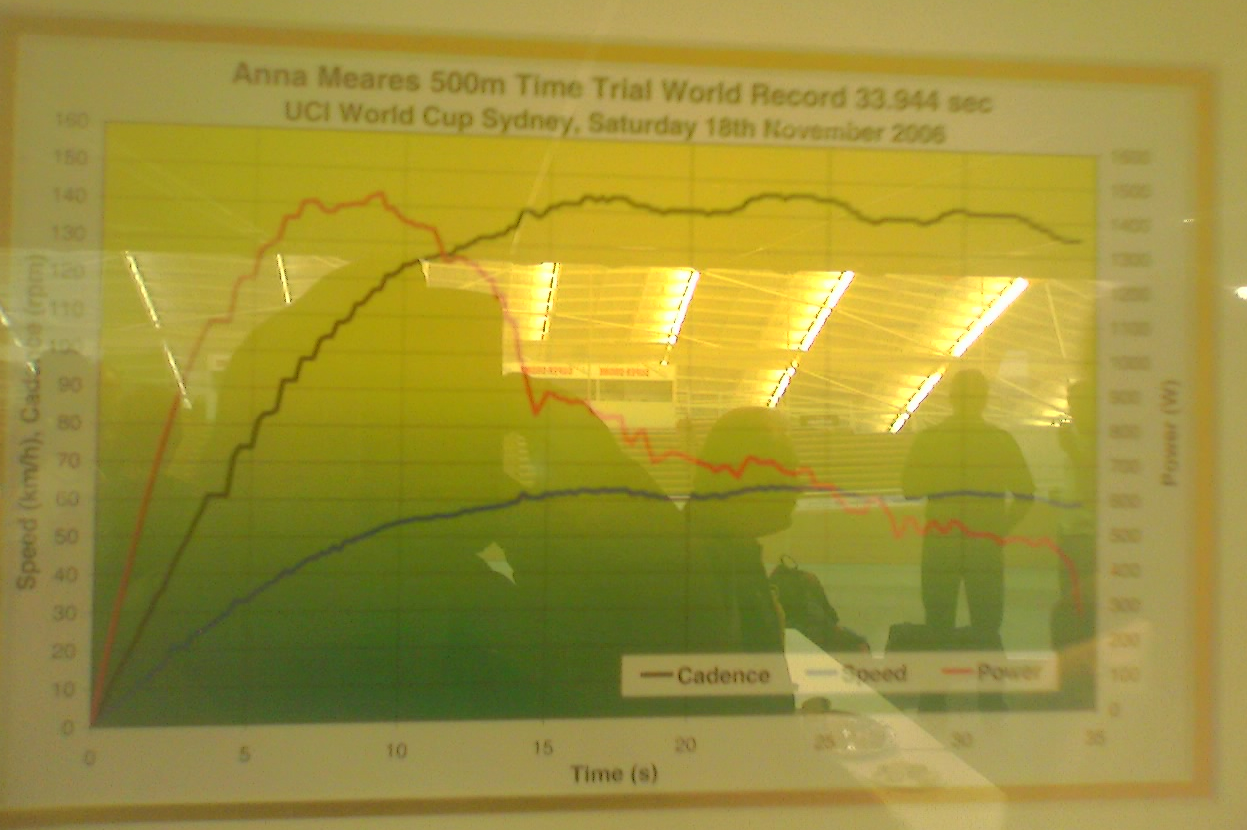 We can learn a lot from how much speed is maintained (or how quickly it decays) after it hits peak. Ie: the power required to slowly decelerate is much less than that which is required to hold constant speed, timing where we hit peak speed in a flying 200 is even more important than we've been thinking it was. (later is better!) - averages are misleading at best when it comes to analyzing sprint performance with power meter software. Have a look at Anna's data from her old world record. Look at the power put out while speed (slowly) decays. Remember KE = 1/2 m.v^2. Which is to say, momentum matters.
Female sprinters are a long term project - making them strong is a priority for their success in the long term. I am not alone in thinking this. Those of you who are female reading this - if you're not already - GET STRONG and be prepared for it to take a long time to happen. Anna spent 10 years getting strong. It's paying off now in spades. She spent her junior days being kicked in the arse by her sister, but she kept on getting strong and look at her now. Junior stars don't always become senior stars, the quick route to success isn't necessarily the best for long term development, ESPECIALLY for girls, ESPECIALLY where the rules are such that strong kids get handicapped by small gears. (we all know my rant on that!)
Get strong, go fast. Simple!
2012-03-29
If you want to be a sprinter ...
Sprint!
Quite often I receive constructive criticism about my recommendation that if you want to be a track sprint cyclist, you should specialise early. That's ok, this is a big world and there's room for lots of opinions.
What do Chris Hoy, Anna and Kerrie Meares, Ryan Bailey, Robbie McEwen, Shanaze Reade, Ziggy Callan and Willy Kanis have in common?
They raced BMX as kids.
What sort of training do BMX'ers do? Sprint. Their races are very short, very sharp. Food for thought?


