tips and hints
2009-11-25
More on the evils of sugar
I'm starting to sound like a conspiracy nut ....
From this article.
The good news, exercise, in particular resistance training, is really good for you, even though for basic energy level control it's not that good it's own :
Exactly, in fact exercise is the best treatment. The question is why does exercise work in obesity? Because it burns calories? That's ridiculous. Twenty minutes of jogging is one chocolate chip cookie, I mean you can't do it. One Big Mac requires three hours of vigorous exercise to work that off, that's not the reason that exercise is important, exercise is important for three reasons exclusive of the fact that it burns calories.
The first is it increases skeletal muscle insulin sensitivity, in other words it makes your muscle more insulin sensitive, therefore your pancreas can make less, therefore your levels can drop, therefore there's less insulin in your blood to shunt sugar to fat. That's probably the main reason that exercise is important and I'm totally for it.
The second reason that exercise is important is because it's the single best treatment to get your cortisol down. Cortisol is your stress hormone, it's the hormone that goes up when you are mega-stressed, it's the hormone that basically causes visceral fat deposition which is the bad fat and it has been tied to the metabolic syndrome. So by getting your cortisol down you're actually reducing the amount of fat deposited and it also reduces food intake. People think that somehow exercise increases food intake, it does not, it reduces food intake.
And then the third reason that exercise is important, which is somewhat not well known, but I'm trying to evaluate this at the present time, is that it actually helps detoxify the sugar fructose. Fructose actually is a hepato-toxin; now fructose is fruit sugar but we were never designed to take in so much fructose. Our consumption of fructose has gone from less than half a pound per year in 1970 to 56 pounds per year in 2003.
The next thing is our old 'friend' fructose again. Fructose really is a killer....
high fructose corn syrup came on the market after it was invented in Japan in 1966, and started finding its way into American foods in 1975. In 1980 the soft drink companies started introducing it into soft drinks and you can actually trace the prevalence of childhood obesity, and the rise, to 1980 when this change was made.
Correlation isn't causation, of course ...
the only organ in your body that can take up fructose is your liver. Glucose, the standard sugar, can be taken up by every organ in the body, only 20% of glucose load ends up at your liver. So let's take 120 calories of glucose, that's two slices of white bread as an example, only 24 of those 120 calories will be metabolised by the liver, the rest of it will be metabolised by your muscles, by your brain, by your kidneys, by your heart etc. directly with no interference. Now let's take 120 calories of orange juice. Same 120 calories but now 60 of those calories are going to be fructose because fructose is half of sucrose and sucrose is what's in orange juice. So it's going to be all the fructose, that's 60 calories, plus 20% of the glucose, so that's another 12 out of 60 -- so in other words 72 out of the 120 calories will hit the liver, three times the substrate as when it was just glucose alone.
That bolus of extra substrate to your liver does some very bad things to it.
Ok, so sucrose, or common table sugar, is 50% fructose and 50% glucose (glucose is ok, by the way, and it's the sugar in Staminade, but not in Powerade or Gatorade ... which is why we use Staminade in aboc C4P!). Sucrose is just as bad as high fructose corn syrup.
fructose is famous for causing hypertension
And here we go :
Robert Lustig: There's clear scientific evidence on the fructose doing three things that are particularly bad in the liver. The first is this uric acid pathway that I just mentioned, the second is that fructose initiates what's known as de novo lipogenesis.
Norman Swan: Which is fat production.
Robert Lustig: Excess fat production and so VLDL, very low density lipoproteins end up being manufactured when you consume this large bolus of fructose in a way that glucose does not, and so that leads to dyslipidaemia.
Norman Swan: And that's the bad form of cholesterol.
Robert Lustig: That's correct. And then the last thing that fructose does in the liver is it initiates an enzyme called Junk one, and Junk one has been shown by investigators at Harvard Medical School basically is the inflammation pathway and when you initiate Junk one what happens is that your insulin receptor in your liver stops working. It's phosphorylated in a way that basically inactivates it, serum phosphorylation it's called and when your insulin receptor doesn't work in your liver that means your insulin levels all over your body have to rise. And when that happens basically you're going to interfere with normal brain metabolism of the insulin signal which is part of this leptin phenomenon I mentioned before. It's also going to increase the amount of insulin at the adipocyte storing more energy. And you put all of this together and basically you've got a feed forward system of increased insulin, increased liver fat, liver deposition of fat, increased inflammation -- you end up with non-alcoholic fatty liver disease. You end up with your inability to see your leptin and so you consume more fructose and you've now got a viscious cycle out of control.
So who's doing this? the food industry .. Sell more! Make more profit. Unregulated capitalism at work ...
We can only eat 1,800 calories per capita per day. In other words the American food industry makes double the amount of food that we can actually use. Who eats the rest? We do, through this mechanism, they actually know that by putting fructose into the foods that we eat, for instance pretzels -- why do you need fructose in pretzels, why do we need fructose in hamburger buns?
Fructose makes you eat more, and makes you fat. It's perfect for making people buy more food.
How do we avoid this nasty stuff?
Norman Swan: Well given that you're not going to come to harm by reducing the fructose in your diet -- somebody who's listening to this -- what's the ingredient on the packet, or the jar, or the back of the tin that tells you there's fructose in there because it won't always say fructose will it?
Robert Lustig: Well high fructose corn syrup, it should say that, now in Australia for instance the sodas don't have high fructose corn syrup they have sucrose. Well sucrose is half fructose. You know a lot has been made over this high fructose corn syrup being particularly evil. In fact high fructose corn syrup is either 42% or 55% fructose, the rest is glucose. Well sucrose is 50% fructose the rest is glucose. In fact high fructose corn syrup and sucrose are equally problematic.
Norman Swan: Basically table sugar.
Robert Lustig: Table sugar -- that's right. We were not designed to eat all of this sugar, we're supposed to be eating our carbohydrate, particularly our fructose, with high fibre. Well the fact is we have 100 pound bags of sugar that go into the cakes, and the donuts.
So don't drink orange juice, eat oranges :
Juice is part of the problem and there's plenty of data, not just mine. Miles Faith had an article in Pediatrics, December 2006 showing that in toddlers, in inner city Harlem in New York, in toddlers the number of juice servings correlated with the degree of BMI increase.
Toddlers drinking orange juice makes them obese!
And anyone who works for a soft drink company should be thrown in gaol. Coke, Pepsi, Schweppes ... These evil bastards are loading drinks with salt to make you thirsty, sugar to hide the taste of the salt and spike your insulin levels to make you hungry, and the side effect of this increased sale of their crap is obesity. Same with my favorite, Big M. Whole milk is great for you, flavoured milk is chock-full of sucrose, which is 50% fructose, and that's the bugbear. Damn you to hell, Big M!
2009-10-11
Addressing your limitations
Or, what's holding you back from achieving what you want to?
This blog entry won't be the full story, but I will expand on it over the next couple of weeks (is that a teaser?!). A few months ago Shane Miller and I were chatting about training philosophies, and the old 'train your weaknesses, race your strengths' meme was the topic.
The gist of it, which we were in rigorous agreement on, was this. Don't train your weaknesses, train (or improve etc) your limitations. For example : if you're a terrible climber (like I am! My big weakness as a roady was that as soon as any sort of hill was in a race course I was rooted) rather than waste lots of time training that and getting demoralized and giving up, accept it and look at what you enjoy racing or riding and look at what's limiting your performance in the sort of event you love to do.
Drawing something useful from that as a quick summary - Find the events you love to do, work out what your limiters are in that event, and work on them. Forget the stuff you suck at, it's not fun, pick the things you love to do and concentrate on making them as good as you can.
A small tangent, for 99% of us, it's not about the gear. It's probably not your bike that's holding you back. Here's an extract from a posting I put up on the BV forums recently that I think explains what I mean :
I coached a guy who won his way up to A grade on a $800 entry-level Learsport roady. The only real difference once he splashed for something fancier is that more people would talk to him (roadies are a funny lot ... when I splashed for my Madone I noticed a lot more people saying 'hi' at Glenvale ... I hadn't changed ...). Tommy Leaper set a very fast ITT time on the 'Boule last winter on a fixed gear cheapy trackbike, beating many on ITT rigs. He also won his way to an Austral final on an ancient steel dunger track bike about two or so years ago, everyone else was on BT's, Teschners etc ... Andrew Steele set the fastest F200 time at BBN on a steel frame that these days no-one would buy except some hipster fixie d00d to do skids on, but no-one's beaten his record yet ... It ain't the bike that wins the race. If you think you need ceramic bearings, you're wrong. If you think you need Dura-Ace, you're wrong.
When I was a kid, I did a lot of rock climbing at Mt Arapalies, I'd spent 3 weeks sieging my way up Little Thor (21). I had all the fancy stuff you could have at the time (mid to late 1980's), the sticky boots, lycra pants etc, I was a card carrying gearfreak. A guy came along who I knew more by reputation than anything else much and solo'd up it in a pair of Dunlop KT26's and he was wearing jeans. Lesson learned .. It's NOT the gear. Racing D, C, B grade, and even most A grade, it's not the gear that's holding you back.
Ob disclaimer: I work at an LBS and would love to sell you a flash bike with pose value and a big markup, but I won't lie to you and say it'll make you faster or that you need it to race ... it might make you more 'friends' at Cafe w4nk3r thoughI have some very nice and expensive bikes and bits, but they don't make me any faster, they're nicer... sure, and IMO very pretty, but the bike is not what's limiting my performance. I wish it was, then I could spend my way to glory and race the sprint at the 2012 Olympics
heh ...
2009-09-28
WADA changes for doping in 2010
Asthmatics, no TUE needed for Ventolin, for hayfever sufferers, pseudoephedrine is back on the list
2009-09-25
So that's why our Spin sessions are so popular?
A study on group training and resistance to pain
From this extract titled "Rower's High"
Physical exercise is known to stimulate the release of endorphins, creating a mild sense of euphoria that has rewarding properties. Using pain tolerance (a conventional non-invasive assay for endorphin release), we show that synchronized training in a college rowing crew creates a heightened endorphin surge compared with a similar training regime carried out alone. This heightened effect from synchronized activity may explain the sense of euphoria experienced during other social activities (such as laughter, music-making and dancing) that are involved in social bonding in humans and possibly other vertebrates.
That might explain why it's much easier to train hard on an ergo (and keep coming back for more!) at our Spin sessions than on your own.
2009-09-20
Can't vs Won't
Not a quote from Star Wars' little green alien ...
I stumbled over this on one of the crossfit websites today:
When an athlete says "can't", a coach hears "won't". To unlock your true potential you need to remove "can't" from your vocabulary. Or at the very least, be honest with yourself and what you truly mean when you say it. Try replacing "can't" with "I don't want to try because I might fail" and see whether your attitude matches your goals.
2009-09-09
We don't dabble in aerodynamics, but ...
Just to show that aerodynamics is a very fickle and often counter-intuitive thing ...
Roadies don't care much about aerodynamics, most of the time they're drafting. MTB riders aren't going fast enough to care. Time trialists and sprinters care a lot. At aboc, we don't pretend to know much about aerodynamics, we prefer to claim that the only way to tell if something is aerodynamic is to test it and that many things that look fast aren't necessarily so.
So, here's something that took me by surprise. Pedaling makes very little difference to drag, at least within the confines of this test (~13m/s, ~45km/h). Here's a paper on it. Intuitively, it seems obvious that pedalling faster would add more drag to the bike.
Pedaling cadence showed little effect on the measured aerodynamic drag, with only a 1% variation between test conditions. Thus, any desired pedaling cadence can be used for wind-tunnel testing.
The drag measured for a rider when pedaling is not influenced in a significant way by the speed of pedaling, in the 40-100-rpm range. The drag measured while the rider is pedaling turned out to be a little smaller than the average of measurements taken with the rider's feet stationary at various positions around the pedaling circle. We do not know the reason for this difference, but it is quite small. We conclude that it is valid to take wind-tunnel drag measurements with the rider pedaling anywhere in the 40-100-rpm range.
So there you go. 40rpm, 100rpm ... no big difference in drag. Not what I would have thought! Aerodynamics ...
Placebos ...
Cycling, as many other sporting endeavours are, is full of snake oil and myths, a lot of stuff is placebo ...
[Mod: The late Dr Siff noted: Many of us who have worked in several fields including neuropsychology and psychoneuroimmunology have witnessed similar changes in response to various shamanic, psychological, NLP, placebo and touch therapeutic methods. In fact it is very rare to find ANY therapeutic systems which DO NOT enjoy a level of success at some time or another which is more than sufficient to ensure a regular clientele, whether the method is virtually witchcraft or not. Apparently a success rate of less than 40 percent is quite adequate to ensure that a given therapist maintains a successful practice. By all means state that certain methods may work in certain situations, but don't presume that they do so for scientific reasons which have never been proved.]
2009-07-18
Being more coachable
Or avoiding the 'I know everything' syndrome
Remember when you were a teenager (or if you're younger than that, just put yourself in old-man-shoes for a few moments and bear with me!). You knew everything. Certainly. What you did was perfect. You were the best car driver in the world. You knew all the tricks, all the facts, everything was perfectly clear and if anyone spoke to you about what you were doing, or dared to give you some advice or relate their own experience they were WRONG or out of line, you'd get angry, you'd tell them off, you'd rant on your blog/twitter/facebook page after fuming for days etc, what do they know?!
Then, when you grew up a bit, you began to slowly realise that you didn't know it all and that other people are worth listening to, and even seeking out, their experiences and ideas. That the things you were so sure about maybe weren't cast in stone and a little bit of humility and grace began to be a part of your personality? It's part of growing up.
Around cycling in particular (although I'm certain it exists in other sports and social groups as well) there's a particular breed who are still stuck in that adolescent (my apologies if you are an adolescent, although I don't think a lot of you read this blog, so I'm pretty safe!) mindset. Defensive in their certainly that no-one can tell them anything. Some of them have even coined a name for this unwanted discourse, they call it ADvice and they bandy it around like some sort of a badge of honour. "Don't give ME ADvice, I know it all". That's analogous to "I'm a closed-minded fool who won't listen to anyone else's ideas or experiences, and I'm proud of it". Yah, smart .. very. When, for example, a world champion hands out a bit of advice on the discipline in which he's world champion at, that's damn valuable information. Only a fool would cast it aside and be offended about it being freely given.
Mark Rippetoe wrote of his own experience (we all go through the phase, it seems) where he was training in a gym, and some old guy started to talk to him and make a few technique suggestions. Mark was training like (and he'd say it himself now) a muppet, doing "silly bullshit". He was sure what he was doing was the best. But, he was very very wrong, and after he learned a bit more, came to the stunning (at the time for him) conclusion that he should learn to be more coachable. Ie: learn to listen to the experience and ideas of others. Sure, some (lots!) of it will be bogus, but some of it won't and being exposed to other ideas is never a bad thing. We all need to get better at being coached, we all need to grow up a bit and learn to accept advice and experiences and ideas with grace and humility and to accept it in the spirit in which it is intended - as help and support and interest. Remember, no-one knows it all and ideas and suggestions are valuable, even if the ideas themselves aren't terribly useful sometimes.
We all think what we're doing is the best way to do something (or we wouldn't be doing it that way, right?) but then, often it isn't, and that's when we get to improve. Closing our minds to suggestions and ideas from others is stupid and immature and taking offence at the same is the sort of adolescent behaviour that we should all try and grow out of. Being given advice isn't something to be threatened by, it's an opportunity to learn something new or different and it's given by people who take an interest in the progress of others. Be one of the people that learns things, not one of the ones that knows it all.
2009-07-11
How a coach can interact with riders
We can all improve at how we interact with eachother.
Sometimes, when coaching, I forget that it's not all about me. The role of a good coach is, as well as all the program design, training planning and preparation and sorting the myths from the Stuff That Works, is to be very good at interacting with the people who've chosen a coach as their coach.
It's a big responsibility. As a coach, I have, for example, somewhere between 10 and 30 riders (depending on how you count them!) who've chosen me as part of their team to achieve their goals. This means that I have 10-30 people to manage in a way, but each of them only has one career. I expect that they've chosen me because they trust that I will do my best to be part of their team to help them achieve their goals. It's important, as such, to take the time to listen to them. For example, our Spin sessions. Riders don't come to our training sessions to hear about my latest squat effort or what I did yesterday, they're there to have a solid session that's tailored to their goals and to go home afterwards feeling positive about what they did at the session and about the people they trained with.
How do I know what their goals are? I have to ask them, sometimes coaxing them to talk more about what they want, how they feel and so on. Sometimes it's like pulling teeth, other times it's hard to get a rider to not monopolise my time by chewing off my ear when I have lots to see to! Finding the right balance here is tricky and we can all do better at it and it's important to keep fine tuning how we approach running training sessions. As a coach I have to avoid the temptation to think I'm some sort of a celebrity. Yes, I'm in front of 20 or so people at a spin class and they're all doing pretty-much what I tell them to do, but that doesn't give me cart blanch to expound on my latest adventures, even if it's very tempting. I try to make a point of celebrating riders achievements but we all occasionally slip into the trap of thinking that because we're centre-stage that we're the important person present. I know I'm not, or a least, I try very hard not to be. I know I don't get that right every time, but it's something I'm very conscious of, and my friends know me well enough that they know they can tell me to pull my head in and I won't take it personally and that I'll respect them more for doing so. At least, I hope they know that! If you're reading this, and you know who you are, I think you know you can tell me when I'm out of line and I won't be offended or hurt by it! I'll probably even shout you lunch or something for doing me the favour.
My blog, my facebook stuff etc, that's where I can whack off about what I've been doing and am doing etc, but that's not appropriate at a Spin or DISC session etc, that's where the emphasis is on encouraging and developing riders and celebrating their successes. Sometimes also people need to be told that something they're doing isn't being done as well as it could be, but again that has to be done in an encouraging way. "That's no good" is not a good way to develop an athlete. We need to identify the positives in something a rider is doing and work on improvements to the things that need improving in such a way that it doesn't offend or demotivate the athlete we work with. Some athletes like a "that's rubbish, do it this way" approach but they're rare, most appreciate (and thus, come back again for more!) a more considered approach. We all get it wrong sometimes but I think it's a good thing to consider regularly and to be constantly vigilant against falling into the traps of "I know it all" and "I'm the Star".
2009-05-30
It's good to be lazy
Overshoot - or why it's good to slack off
Type 2b muscle fibres are the ones sprinters want the most of. They're the fastest of the two fast twitch fibres found in human muscle tissue. The more you have, the faster and more powerfully your muscles work and the faster you can go. Enduros don't want these at all, they're next to useless for endurance work. Enduros spend their time trying to convert type two fibres to type one. Type one, or 'slowtwitch' fibres are the ones that go all day, but 10 times slower in contraction speed than fast twitch fibres.
A very interesting article on 'Overshooting' is here.
The gist of it is :
a pattern of heavy resistance training followed by decreased activity causes first a decrease then an overshoot in the proportion of the fastest fibre type in the trained/detrained muscle group.
That's good!
a large increase in training volume for approximately three months will decrease the proportion of IIb fibres in the trained muscles; a subsequent reduction (not cessation) in training volume relative to the heavy resistance training phase should not only reverse this decrease but lead to a significant overshoot in the proportion of IIb fibres. In consequence, the potential for the rapid and forceful muscle contractions so crucial to sprint performance should be enhanced.
This conclusion is in line with the current training practices of many sprint athletes: a heavy resistance training phase followed by a taper in training volume and intensity in the lead up to the competitive season(9). And on the evidence of the Copenhagen research, others would be advised to follow their example, with three months of heavy resistance training followed by three months of relative detraining, with relatively reduced training volume in the run up to key targeted events.
Interesting. One study found an increase from 9% to 18% (double!) the proportion of 2b fibres after a heavy block of training and then a layoff. Ratios on their own are easily misinterpreted but that's a very significant increase. It's rumoured that the British track sprint squad used this phenomenon to great effect in their preparation for Beijing.
Does this mean we should slack off before big sprint meetings? It would seem so, at least in terms of heavy strength work.
2008-09-19
Road rage - strategies
A very good article on road rage
It's by a yank, but is pretty relevant to here. Have a read.
An extract :
My goal is to stay in control of my emotions. When a bad driver cuts me off because he is not paying attention or checking his mirrors, I am able to stay cool. Let someone else ‘teach him a lesson’-whatever I have to tell myself to get through those first critical moments without reacting. In those cases where it seems the bad and dangerous driving was intentionally directed at me-it is very difficult for me to control my knee jerk response to retaliate immediately. It feels like I am ‘giving in’ or in some other way ‘losing’. In order to change my reaction I had to change my perspective. If I lose my temper and escalate an antagonistic situation- what I am really doing is losing control. I try to equate losing my temper with being defeated, with ‘losing’. For me this is often enough to deter my dark side from emerging.
2008-09-01
Static stretching reduces performance
There's a growing body of evidence that says static stretching impairs sports performance
In short, stretching statically before sport will reduce your performance and does not reduce injury risk. Dynamic/full range of motion and mobility stretching is ok, but the old school 'stretch static before you train/play' is out!
This is why we don't do static stretching during our training sessions.
Extract here from one study :
Duration of stretch does not influence the degree of force loss following static stretching.
Brandenburg, J.P., Journal of Sports Medicine & Physical Fitness Dec 2006: Vol. 46 Issue 4. p. 526-534
Abstract: Aim. There is an emerging body of knowledge indicating static stretching (SS) acutely and adversely affects muscle performance.
The practical value of this research is limited considering the lengthy stretch durations under investigation. It is unclear if stretch durations typical of those used pre-exercise similarly affect muscle performance.
The purpose of this study was to determine if SS using more representative stretch durations affects
muscle performance and to establish if changes in muscle performance were influenced by the duration of stretch.
Methods. Following 2 familiarization sessions, 16 recreationally trained males and females participated in 2 randomly ordered experimental sessions. In each session maximal effort hamstring performance was assessed prior to and immediately after 1 of 2 stretching protocols.
During one of the protocols participants were required to hold each stretch for 15 s while stretch duration in the second protocol was 30 s. Both protocols consisted of 3 repetitions of 2 stretching exercises. A Kincom isokinetic dynamometer was used to assess hamstring performance during isometric, concentric, and eccentric actions.
Results. For each of the three muscle actions a repeated measures ANOVA revealed a significant main effect of time (pre- vs poststretch, P < 0.05) but no interaction effect (time x SS protocol). Furthermore, the stretch-induced deficits in muscle performance were consistent across muscle action type.
Conclusions. SS incorporating stretch durations typical of those employed pre-exercise were sufficient to impair muscle performance and the duration of stretch did not influence the degree of force loss. Inclusion of SS, even with short stretch durations, in preparation for
strength activities is not appropriate.
2008-08-25
The interferance effect
Or, combining peak power training with aerobic training - good for enduros .. BAD for sprinters!
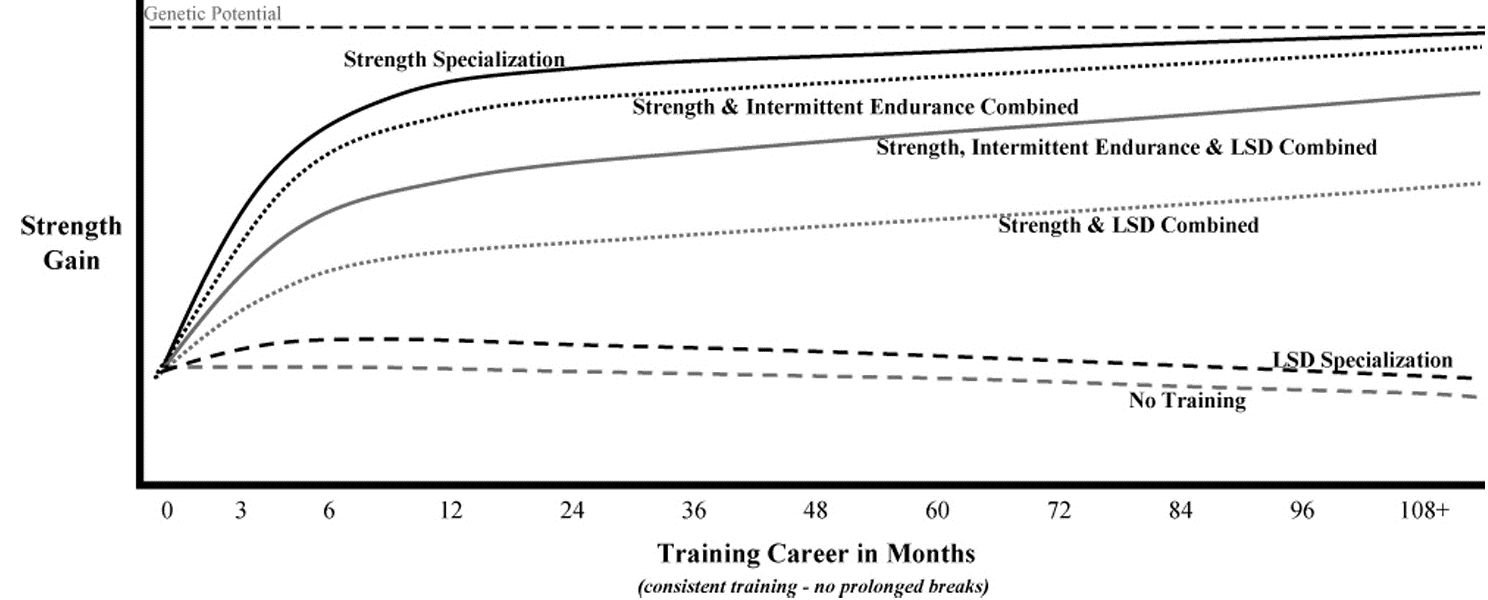
I wrote an article in the tips & hints section of the site today. summarising some stuff I've been reading and asking people about here and there about the effects that aerobic training has on strength and power training. In short, strength training doesn't hurt enduros, but enduro training has a negative impact on sprinting.
The article is here.
2008-04-20
How to lose a race
In May 2004, Eric Zabel, in April 2008, Tom Boonen ...
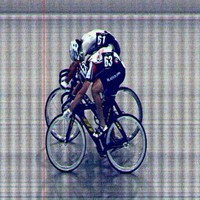
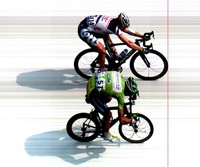
An old rule for sprinters, never celebrate until you've crossed the line. NEVER!
Eric Zabel is a classic case, in the 2004 Milan San Remo, he threw his hands up, only to see Oscar Freire throw to take the win.
And just a few days after his domination of the 2008 Paris-Roubaiux Tom Boonen did the same thing.